By Paul Rozycki
It took the U.S. and its allies just under four years to defeat Nazi Germany and Japan in World War II. It took eight years for the U.S. to fulfill President Kennedy’s 1961 promise to land a man on the moon before the end of the decade. And it took less than a year to develop a vaccine to combat the COVID pandemic.
Yet, after 12 years, the Flint Water Crisis has not yet been resolved. Though, as reported in a MLive headline last month, “The last service line replacements, [and] lawn restorations may begin soon.”
It may be an unfair comparison, but to this Flint resident, it seems like defeating the Nazis, landing humans on the moon, and global cooperation to develop a vaccine should present a greater challenge and take more time than repairing our city’s water system.
A brief history of the Flint water crisis
For those of us living in Flint, the history of the water crisis is both a familiar and complex one that we all recall by our own experiences. But for others, here are a few key points from the last 12 years.
In 2014, Flint’s emergency manager, Darnell Earley, ordered a switch from the Detroit Water System sourced in Lake Huron to water from the Flint River to save money. Critically, though, that switch was made without adding appropriate anti-corrosive chemicals, and Earley’s cost-saving measure proved to be incredibly costly.
Almost immediately residents complained about the taste and color of their water, and General Motors stopped using it as it corroded metal engine parts. The date of the water switch, April 25, 2014, is considered the start of the Flint water crisis.
In 2015, after many reports of high lead levels in the water, Governor Rick Snyder ordered Flint switched back to the Detroit Water system. Later that year, Dr. Mona Hanna began a study (published early the next year) showing elevated blood lead levels in Flint’s children, and Mayor Karen Weaver declared a state of emergency in Flint.
In 2016 the Michigan National Guard began to distribute bottled water to Flint residents, and both Gov. Snyder and President Barack Obama declared a state of emergency in the city, offering financial aid. A number of officials, including Earley, began to see criminal charges for their part in the water crisis.
In 2017, a settlement was reached to provide $97 million for pipe replacement for as many as 18,000 Flint homes over the next three years. That same year, Flint’s water began testing below the federal threshold for lead, as reported by the Michigan Department of Environmental Quality (MDEQ).
In 2018, the state announced that the free bottled water distribution to Flint residents would end, though the pipe replacement program was not yet complete.
In 2019, Attorney General Dana Nessel dismissed charges against multiple people involved in the crisis, noting she would be restarting the investigation. In February 2020, after missing a Jan. 1 deadline to replace all impacted service lines, the city announced that 9,516 lead pipes had been replaced. By 2021 Attorney General Nessel announced criminal charges against former Gov. Snyder and eight other defendants involved in the water crisis.
In 2022, the Michigan Supreme Court overturned the use of a one-man grand jury to issue indictments against those charged in the water crisis. The city says it has replaced 10,059 lead pipes and hopes to have the service line replacement process complete by the end of the year.
In 2023, Genesee County Circuit Court David J. Newblatt approved a $626 million settlement with the State of Michigan, City of Flint, McLaren Regional Medical Center, and Rowe Professional Services. At the time, more than 50,000 people had registered to file claims for the settlement funding.
In 2024, the City of Flint was held in contempt of court for its failure to meet the deadlines for pipe replacement.
In 2025, City officials said about 97% of lead service line replacements were complete, according to reporting by the Detroit Free Press. The State of Michigan reached a $53 million settlement with Veolia North America (VNA), a Boston-based company that, the state claimed, contributed to the water crisis by failing to properly identify corrosion control treatment issues. (VNA continues to reject that assertion.) In May, the Environmental Protection Agency (EPA) lifted its emergency protection order, imposed in 2016, declaring that Flint water officially met federal standards. The EPA also noted that Flint’s water had tested below federal lead limits for nearly a decade.
Which brings us to now, April 2026, when payments are finally starting to trickle in to claimants and fewer than 1,000 service lines still require work according to recent reporting by MLive.
So, 12 years on, we’re almost at the end of the water crisis – but not quite yet.
The water crisis of today: what has and hasn’t improved
In 2026, at least we seem to be near the end of the service line replacement process, and reports in recent years have shown the water to be safe and regularly meeting federal standards.
Though there were many delays and missed deadlines, almost all of the lead service lines in Flint have been replaced. And while we became the poster child for water issues (Flint made the cover of Time Magazine in 2016 with the headline “The Poisoning of an American City”), Flint also proved to be a warning to other places facing similar water issues – motivating them to take action.
But despite the strides in water quality and leadline replacements, there are impacts of the water crisis that can’t be mitigated with money, time, and infrastructure changes. Perhaps the greatest result of the water crisis has been the loss of trust in many levels of government.
Decisions by Gov. Snyder and top level MDEQ officials – with most never being held accountable in court – have eroded the public trust. And with “three years” turning into “three mayoral administrations” of leadline replacements in Flint, it’s no wonder residents continue to distrust local leadership regarding water quality to this day.
While payments have finally begun for adults who filed for compensation, the long delay in water settlement payouts may be an example of both the positive and negative aspects of the whole water crisis. Yes, it is great that some of those harmed finally received financial compensation, but the delay and complex hurdles that many had to go through to get those funds were daunting, and many are still waiting for their check in the mail – or may never get one.
One of my wife’s friends suffered medical issues when the water crisis began and has been trying for years to win compensation. She has had to go to several offices a number of times, stand in long lines for hours, and repeatedly contact her doctor for medical reports. Six months ago she was asked, again, to resubmit more information, and she still hasn’t received any payment. She described the whole process as “a nightmare” and that she “was ready to give up.” She even said “I’m done with it” if nothing happens from this last attempt in her years-long effort.
What have we learned?
There are at least several lessons we can take from the last 12 years of managing the Flint Water Crisis.
One is the old maxim that “an ounce of prevention is worth a pound of cure.” In order to save a few dollars the emergency manager switched to Flint River water. It may have been a little cheaper, but it proved to be enormously more costly in the long run.
Another is that honesty matters. After all the false promises that the water was safe to use and drink, people began to distrust many of the official statements about the water crisis – even when our water was testing well. After prosecutions of those involved in creating the crisis were set aside, many people, especially Flint residents, became even more cynical of the government systems meant to serve and protect them.
But, if there is a plus side, we’ve also learned that it can be done – we can reach solutions to our most difficult issues – albeit with constant advocacy. Even with all the delays, frustrations, and other problems that Flint is facing, nearly all the pipes have been replaced for our occupied homes, and payments are starting to be made to impacted residents.
Over the last decade, Flint also produced a number of leaders who were willing to step forward and take action to make the water safe again. Among them are Miguel Del Toral, the EPA regional manager who first expressed concerns about the lack of corrosion controls; Marc Edwards, Virginia Tech environmental professor, who researched the leaching of lead into Flint water; LeeAnne Walters led a citizens’ movement after lead levels in her water were testing at over 100 parts per billion (ppb); and, of course, Dr. Hanna, who reported on the impact of lead in children.
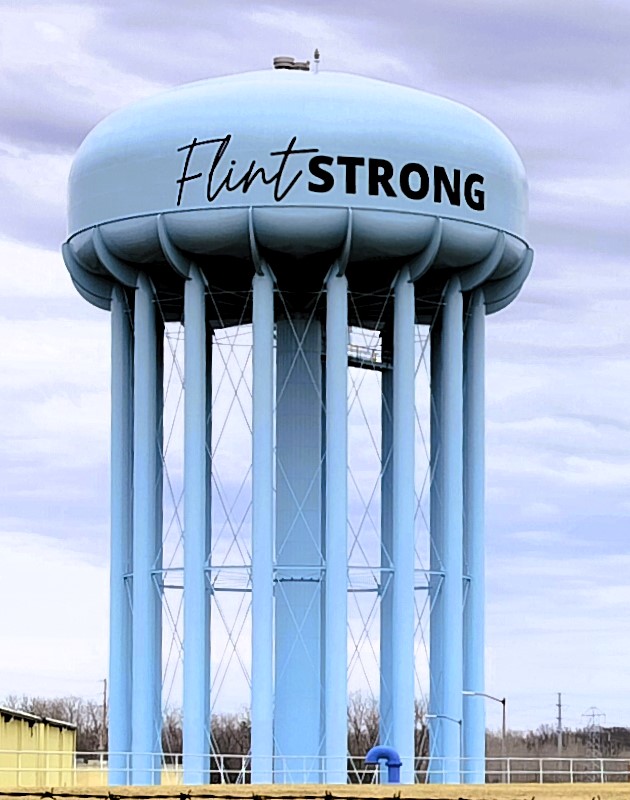
After 12 exhausting years it seems fair to say a solution to the water crisis hasn’t been simple or quick. And while the leadline replacement work is nearly complete, replacing the pipes won’t end the frustration and distrust that has grown out of the water crisis. The Flint water tower may say “Flint Strong” but the long story of the Flint water crisis tells a very different story, and there is more work to be done for the city to truly earn that title.
Editor’s Note: This article first appeared in the April 2026 print edition of East Village Magazine.