By Flint. Daily. and EVM Staff
Voters in Flint’s Fifth Ward will have a new city council representative next year, as current Councilwoman Jerri Winfrey-Carter announced in January that she would not seek re-election. Winfrey-Carter, voted into office in 2017, will have served two terms when she leaves office later this year.
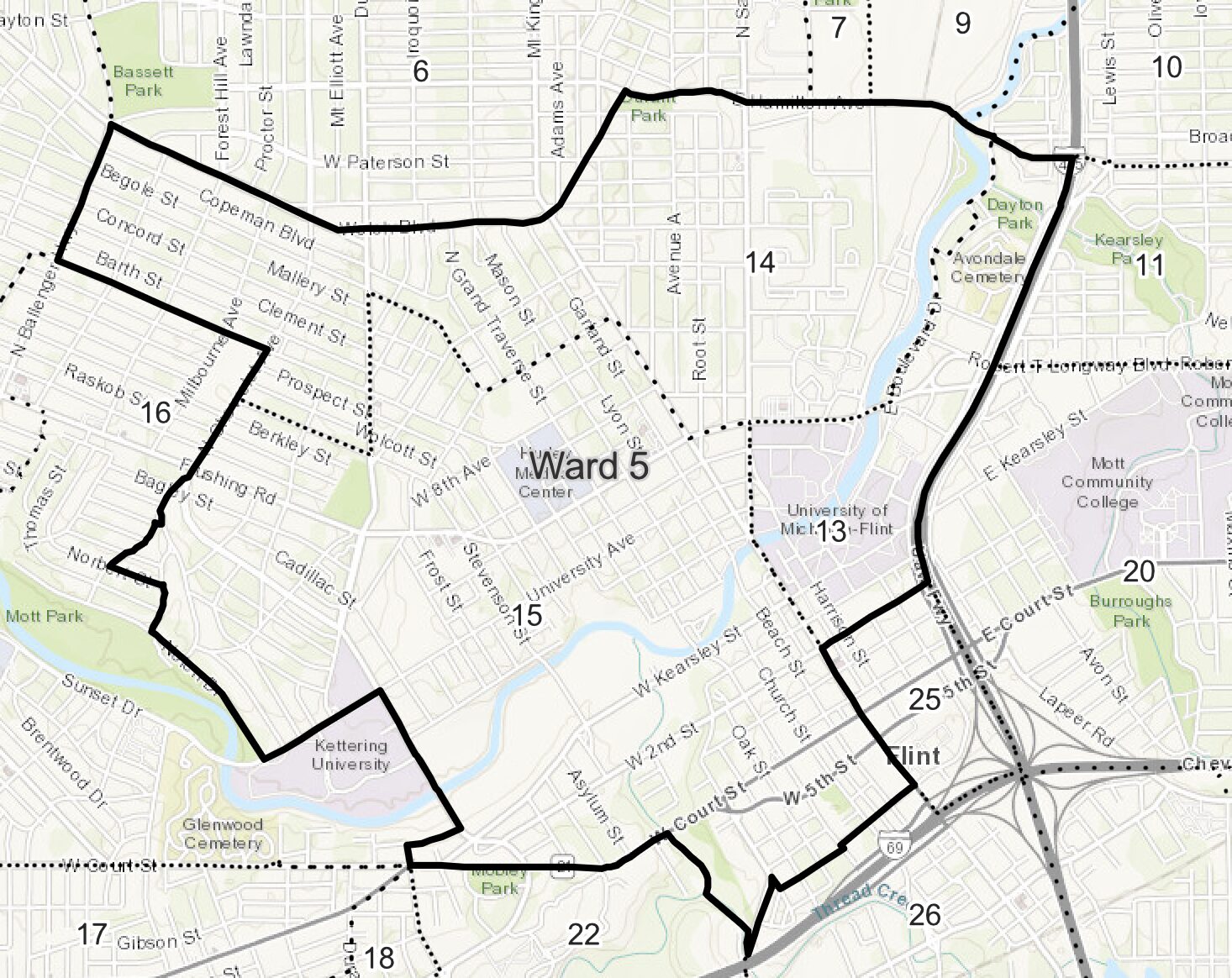
The Fifth Ward encompasses much of Flint’s downtown, including anchor institutions like University of Michigan-Flint and Hurley Medical Center, as well as historic areas, a portion of the Mott Park neighborhood, and a significant amount of park spaces that will be part of Flint’s new state park project. The ward’s boundaries are visible on the city’s interactive map.
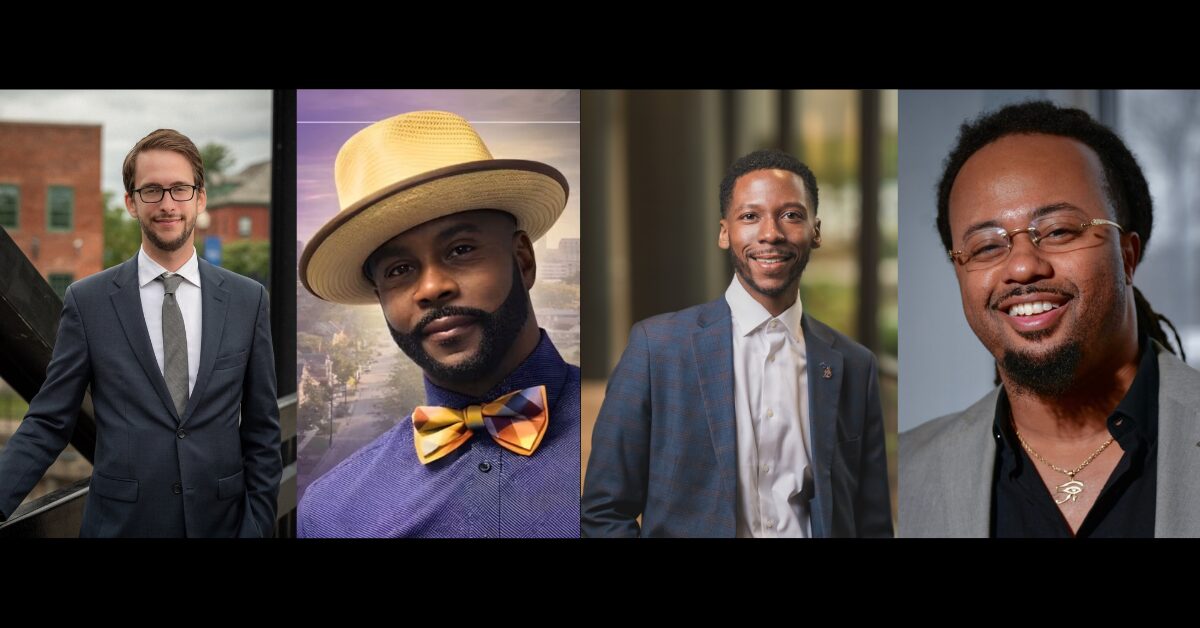
Four candidates are on the Aug. 4 primary ballot: Joel Arnold, Wantwaz Davis, Jeron Dotson, and DeWaun Robinson. The top two vote-getters will advance and face each other in the general election on Nov. 3. All four responded to a questionnaire by East Village Magazine and Flint. Daily. leadership that was designed to provide readers with a brief snapshot of each candidate’s background, experience, history and connection with Flint, priorities should they win their seat, and their thoughts on recent examples of Flint City Council votes. Their responses are listed alphabetically by last name below.
More background about the questionnaire, our methodology, and the partnership between East Village Magazine and Flint. Daily. publications is available in our story announcing the collaboration last week.
We will publish one story each day in this order:
- Eighth Ward Primary – July 8
- Fifth Ward Primary – July 9
- Second Ward Primary – July 10
- First Ward Primary – July 11
- Mayoral Primary – July 12
All candidates in a primary, including certified write-ins, were contacted at their publicly-available email address and phone number listed on their filing forms to take part in this series. However, not every candidate responded to our questionnaire. It will be noted in the coming stories if a candidate did not respond and what attempts were made to contact them. For questions, please reach out to us at team@flintdaily.news or eastvillagemagazineflint@gmail.com.
Age:
- Joel Arnold: 32 (33 After July 9).
- Wantwaz Davis: 52.
- Jeron Dotson: 33
- DeWaun Robinson: 39.
Occupation/relevant professional experience:
- Arnold: Currently I serve as Policy Director at Abundant Housing Michigan. Previously I spent 5 years as the Planning and Advocacy Manager at Communities First, Inc., where I managed neighborhood planning and public policy work focused on building healthy, vibrant communities. Before that I spent 3 years in Philadelphia working in community development and also worked in the City of Flint’s Blight Office.
- Davis: Owner of a custodian company, cleaning schools and residential properties, including post construction cleaning, for 11 years.
- Dotson: Business owner of The Poke Bowl. I’m also a reserve deputy with the Genesee County Sheriff’s Office. I used to be an administrative assistant with the Michigan Department of State. My first professional job was at the Secretary of State’s office in downtown Flint.
- Robinson: Building Community Partners Peer Recovery Coach Supervisor; Flint Housing Commissioner; nonprofit management.
Education:
- Arnold: Bachelor’s Degree in Social Relations and Policy/Urban and Regional Planning from Michigan State University. Master of Public Policy degree from University College Dublin, with a specialization in Urban Policy.
- Davis: Some college in communication, no degree.
- Dotson: Graduate of University of Michigan-Flint in international business and marketing. My minor was Mandarin Chinese. I also studied at National Taipei University of Education for a semester in order to fulfill credits in international business.
- Robinson: Graduate of Flint Central High School; Associate degree in Computer‑Aided Drafting and Design; Bachelor’s degree in Nonprofit Management; extensive professional training in peer recovery coaching, trauma‑informed care, and community leadership.
How long have you lived in Flint?
- Arnold: I have lived in Flint a total of 7.5 years. I was born at McLaren Hospital, moved into the city permanently in 2015, moved away for graduate school in 2017 and then moved home in 2021.
- Davis: 52 years.
- Dotson: Pretty much my whole life. I graduated from Grand Blanc Schools, but my family and I have always lived here.
- Robinson: Born and raised here.
How long have you lived in your ward?
- Arnold: I have lived in my ward for approximately 1 year. I previously lived on Crapo St. and on Court St. downtown.
- Davis: 52 years.
- Dotson: For about five years.
- Robinson: 10 years at my current address, but my family home has always been in the Fifth Ward, so I’ve lived here all of my life.
What neighborhood or area of your ward do you live in?
- Arnold: Carriage Town.
- Davis: Fifth Ward.
- Dotson: University Avenue Corridor.
- Robinson: Metawanee Hills.
Do you own or rent/lease a residence outside of your ward? If so, how often do you stay there?
- Arnold: I do not.
- Davis: No.
- Dotson: No.
- Robinson: No — I only have one home, and it’s right here in the 5th Ward. This is my sole residence.
Do you promise voters that you will file your campaign finance statements by all required pre- and post-election deadlines for the primary and general election? If not, have you filed a Reporting Waiver and promise voters that your campaign will not receive or expend more than $1,000 in your election bid, per that waiver’s requirement?
- Arnold: Yes. I will file all required campaign finance reporting on time. I did not file a Reporting Waiver.
- Davis: Yes.
- Dotson: Yes.
- Robinson: Yes. I’m committed to full transparency and will file all required campaign finance statements on time. I stay in regular communication with our campaign treasurer to make sure everything is submitted accurately and on schedule.
What things do you enjoy doing in the city for fun or in your spare time?
- Arnold: There’s so many things I love about living in this community. I love riding my bike so I regularly use the Flint River Trail, the Genesee Valley Trail, Max Brandon Park, and the trails in Chevy Commons. The summer event season is a highlight in our city from Porch Fest to 810 Day, Back to the Bricks, Juneteenth, the Crim, and more. As a board member at Friends of the Alley I helped put on four years of Alley Fests (2022-2025) so that event holds a special place in my heart. I also love the cultural events we have in Flint like Art Walk, the amazing events put on by Jeff Skigh, CFI’s Levitt AMP Flint Concert Series behind Totem Books, and our great sports teams like the Flint City Bucks, Flint City AFC, the Flint Firebirds, and more. My church, St. Paul’s, is also deeply important to me.
- Davis: I don’t find many places in Flint, Michigan, exciting, besides engaging with residents in my ward about issues that concern them. I love engaging with residents, educating them, and being educated by them. I travel to other states often, like Florida.
- Dotson: My family’s still here, so I spend time with them. And when we’re chilling here, most of the time we go to the Farmers’ Market, we go to my mother-in-law’s house on the northside, Carpenter Road area, and then here at the Poke Bowl. We take our nieces and nephews to Flint Style Soccer. I’m mostly here at the Poke Bowl because I live here and I work here. But we also hang out downtown Flint.
- Robinson: I enjoy spending time with family, supporting local events, mentoring youth, and uplifting cultural celebrations that bring Flint residents together. You’ll often find me at Back to the Bricks, the Crim, Kwanzaa, and Juneteenth. I love visiting the North Flint Food Market and eating at food trucks, as well as spending time at the Cultural Center, Riverfront, Berston Field House, Farmers’ Market, the new McCree Theatre, and local senior centers — places that show Flint’s heart, history, and community spirit.
What boards or community organizations have you been involved with?
- Arnold: I have been a board member on the boards of Friends of the Alley and St. Paul’s Episcopal Church. I am the co-founder of Strong Towns Flint, where I serve as board president today, and serve on the board at Flint Fresh as well. I am actively involved with the Carriage Town Neighborhood Association and Flint Neighborhoods United.
- Davis: Former fifth ward city councilman, 2013-2017.
- Dotson: Ruth Mott Foundation community engagement board member, which was getting out in the community, figuring out ways that we could talk and survey them without us feeling like a test subject. St. Mark Missionary Outreach where we focus on mental health, food insecurity, youth engagement., Genesee County’s Care Team which handles adult and elder abuse, Michigan Secretary of State’s Collegiate Student Advisory Task Force, DoorDash International Restaurant Advisory Council as a small business representative.
- Robinson: Traditional Flint Juneteenth Committee (Chair); Black Lives Matter Flint (President); Artistic Visions Enterprise (CEO); Urban Renaissance Center (COO); Community Based Organizing Partners; Habitat for Humanity (Community Liaison); Rights of Passage & Young Visionaries programs; Greater Flint Art Council Board of Director; Flint African‑American Leadership Dialogue; Steering Committee leadership team; My Brother’s Keeper; Young Professionals of Flint & Genesee Chamber; Habitat Young Professional Ambassador; Master Plan Committee; Flint NAACP; Generation Forward; Phi Eta Psi fraternity.
What made you decide to run for City Council?
- Arnold: I decided to run for council because I feel very strongly that the challenges we face in Flint are solvable, but so often we get in our own way. For years our council has been defined by infighting. Basic city tasks like trash pickup, park improvements, public safety and more have fallen victim to this. Yet if we have a council that is focused on the basics – fixing streetlights, fixing potholes and repaving roads, growing our economy, reducing our 911 response time and investing in quality free community programming – we can ensure this is a thriving and welcoming place. My experience working for the city in the Blight Elimination Division and interacting with the city in working to get new housing built at Communities First has made me confident that I could make an impact if elected.
- Davis: Poverty is what compelled me to run for city council. I’ve always had a robust ideal and concise plan to address poverty.
- Dotson: People would often come in here and, because I’m connected to different people or resources or know who to contact for certain issues and I would always help them figure it out. They’d start to say, ‘Dude, you should step into leadership.’ I’m a business owner, I have a family, but when I sat down and talked to them, I started to see how I can make a difference and connect the dots. I’m able to sit with people on fixed incomes and different needs and help them understand the issues. That’s what we need on City Council, is the ability to bring people of all walks of life together. Once your family and the community believes in you and you believe in yourself, and your reasoning is to help, I believe I could use my networking influence and ability to solve problems and bring that to council.
- Robinson: I’m running to restore trust, strengthen neighborhoods, and ensure residents feel heard. I live here, own my home, and raise my family here. I want safer blocks, less blight, stronger small businesses, real youth opportunity, clean walkable neighborhoods, and fair housing. I know what it feels like to have unanswered questions, and I want to help Flint heal and rebuild trust. I decided to step up to work with colleagues with efficient effective local governance, to improve services and pass resolutions that protect residents through transparency.
What separates you from other candidates in your primary election race?
- Arnold: I come to this race with a decade of experience in direct community development work. In my very first job after college, I worked in the Flint’s Blight Elimination Division alongside then director Raul Garcia. I coordinated the city’s response to more than 10,000 individual blight calls, supported more than 250 community cleanups, and we raised the city’s resolution rate for blight complaints from 33% to more than 75%. I also spent three years in Philadelphia coordinating a multi-million dollar park redevelopment project, rebuilding a beloved community garden, supporting small businesses, and leading a neighborhood planning effort to ensure that the neighborhood’s future was shaped by those who lived there, not outsiders. While working at Communities First, Inc. we built more than 150 quality homes in Flint and brought over $50 million in investment to Flint neighborhoods. No other candidate comes to this race with this level of experience and *proven* results.
- Davis: None of them have ever delved deep into the recess of Flint, Michigan’s, most alarming, detrimental, and threatening conditions the residents in Flint, Michigan, are constantly suffering from, i.e., poverty. Their campaign is conventional and basically substandard, with no cure, more like medication that masks and suppresses our problems.
- Dotson: I’m an entrepreneur, business owner, family man, and I have some experience in public safety. A big part of city council is managing budget, hitting deadlines, and we do this daily here at Poke Bowl. It’s about good service, and we do that here too. That’s what a city council’s supposed to do, make sure the budget is allocated, and that the service is improving the quality of life of residents. I’ve been doing this business-wise for 10-15 years now. We have worked with every level of government from local to Michigan House to Congress in order to get this business going. I’m able to work with different partners, and I can show that there’s a tangible product that happened when I sat down and worked with people. I believe that we need somebody who is dynamic, who can sit with people of different backgrounds and with different entities and organizations, and have some understanding and experience to implement policy that benefits everybody.
- Robinson: As a lifelong Fifth Ward resident, I have long‑standing relationships with families, youth, elders, churches, and small businesses. My experience comes from over a decade of healing‑centered work, cultural organizing, conflict mediation, and hands‑on community service. I’ve supported public safety through restorative‑justice practices, youth mentorship, and neighborhood‑based problem solving. My perspective is shaped by living, working, and serving here every day. I don’t just talk about community — I’ve been serving it for more than a decade.
The City Council has long been plagued by difficult working relationships among council members and with the mayor’s office. How would you create a healthier environment on council and with the mayor to move city business forward?
- Arnold: The key thing here is to realize that each council member is a representative of their ward and deserving of respect. I commit to treating all of my colleagues with civility and respect and to building a good working relationship with all members of the council and the mayor’s office through regular meetings and conversations. We have to remember that at the end of the day these offices are not about us, they are about serving the public. We are just the temporary holders of these offices.
- Davis: Exercising a great form of decorum, and emotional intelligence. Organizing and educating my colleagues of the importance of not being selfish. Enforcing the principle of working together. We are better and much more effective working together than being divided, regardless of our differences in beliefs. That includes working with the mayor and his/her administration to fulfill what the main goal should be, i.e., moving Flint, Michigan, forward economically and socially.
- Dotson: It’s important to have some of the same vision for the city: a safer Flint, a Flint with jobs, a place that people feel safe bringing their kids to patronize the city or opening a business. Once we move in that way, we’ll figure out we have much more in common than not. I don’t think there’s any room when it comes to doing what’s best for the residents. When it comes to allocating money, saving the residents money or lowering costs, that should always be at the forefront. That should separate most divisions. We have to work with the mayor and at the same time see to all the interests in our wards. I’m not coming at this as, ‘Hey, this is what I wanna do or what I believe.’ It should be, ‘This is what we believe. This is what my constituents believe.’ I know a decent amount of the people in the chairs or the people who are vying to get in the chairs, and I have good relationships, it’s a blank slate to be able to work with everybody effectively.
- Robinson: Even when personalities or opinions differ, my motivation stays the same: serving people with transparency, not ego. I know how to work through differences, move city business forward, and not be held by anyone’s personal agenda.
What do you see as the biggest challenges facing the city?
- Arnold: The city’s three major challenges are crime, blight, and economic development. In reducing crime, I believe strongly that we cannot be satisfied until our 911 response time is the exact same as the national average. We must also work with local police departments and trusted community groups to ensure that we reduce crime and ensure policing is done in a safe, effective way. Too many Flint residents live next to abandoned and burned out houses, overgrown grass, and illegal dumping. If elected I will do what I did when I worked in the blight office – keep a laser focus on solving blight issues, catching those who dump illegally in our city, and supporting institutions like the Blight Court. Lastly, so many of our challenges are a result of not having enough good paying jobs. We must focus on making it easy to grow or start a business, invest in our local small businesses, and partner with local schools to ensure that our residents have world class educational opportunities.
- Davis: Addressing poverty. Poverty is the core root problem to many of the improprieties and threatening conditions in Flint, Michigan, that has devalued our communities, socially and economically. I’m a strong advocate for education. Although, we can’t be working on a strong educational system and ignore hope, opportunity, and jobs for the underprivileged. Flint, Michigan, is an industrial city. Stakeholders and city officials should be working together to usher mass production of jobs (manufacturing) to our city.
- Dotson: We need jobs immediately. We’re strategically placed between major highways, we have a major airport. We have good bones, but it’s about being strategic about how we plan our future, identifying jobs that benefit our community and don’t hurt our environment, that invite people of all education classes to have a job. Second would be public safety, if people don’t feel safe, they won’t come here. We need to invest in mental health and leverage all the resources we already have here like Genesee Health System, the Peacekeepers, people who are good at neutralizing issues. We also need to expand relationships with county and state police. We need more youth programs because that decreases the likelihood of violent crime. We’re facing a housing shortage, and blight is a factor here in Flint with perfectly good homes that people aren’t taking care of, homes owned by outside investors or banks and neglected. We gotta be able to let the people here be able to buy back their block.
- Robinson: Changing the public and national narrative is one of Flint’s biggest challenges, especially the backlash from being known for bad water and high crime but not for the sports legacy or college town identity that’s just as prominent. The city faces aging infrastructure, slow service delivery, and long‑term disinvestment. Public safety, food deserts, economic instability, housing insecurity, transportation barriers, poor grades, limited jobs, and unstable living conditions strain families. People and businesses hesitate to move or invest. Poor healthcare, gaps in senior support systems, and the lack of malls, banks, movies, and hotels deepen negative perceptions.
What do you see as Flint’s greatest assets or opportunities for the future?
- Arnold: The best thing about Flint is its people. We are blessed with a community full of people who do the small things every day to keep their neighborhood and their communities great places. We must support them by building on the assets that we have in our city. From our universities and colleges to our hospital systems to our enormous park network to our philanthropic partners, Flint has so many assets it can build on. If we focus on getting the basics right as a city government, we can better utilize these assets and ensure that all of our neighbors have what they need to live great lives.
- Davis: Using our green space or industrial land for manufacturing jobs, not data centers. I convinced the Genesee County Chamber of Commerce in 2015 to usher to Flint, Michigan, manufacturing jobs and place them on some of the Buick locations. The Chamber recruited five-year economic and development contracts from emergency manager Jerry Ambrose, April 2015 to June/July 2020, 7 months before mayor Karen Weaver was elected. LEAR Manufacturing was the first, hiring 800-1,000 workers in the 5th ward. Manufacturing jobs will create a strong economy and tax base, including building a stronger population. People will move to Flint, Michigan, to work.
- Dotson: Our people are our biggest asset, and where we are placed location-wise. We have the corridor with the four expressways, we have a major airport. That’s infrastructure that isn’t going anywhere. We just gotta find a way to take advantage of it. We have Kettering, which is a top engineering school. We got UM-Flint, which I’m a proud graduate of. We also got Mott Community College. So it’s about taking advantage of them, putting the people first and investing in our people. Back in the day, with General Motors, we had a hard working class. No matter what, you couldn’t beat Flint’s workers. That working class hasn’t gone anywhere. We just have to identify employers or an industry that can put us back on the map. I think it’s imperative that we take advantage of our strengths as our people and location, and find industries that employ our people so they can invest back into their neighborhoods and households, and give people from out of the area a reason to move back here.
- Robinson: As a college town with UM‑Flint, Mott, and Kettering, the city has strong resources for education, entrepreneurs, and innovation. General Motors’ presence, new housing for young adults, and historic areas like Carriage Town support growth. Financial resources from the water crisis aid recovery. Flint is a place of forgiveness, offering second‑chance hiring for residents. Even when so much has been lost, opportunity remains. Flint is a blank canvas, and our people are ready to paint their dreams into reality.
What would be your top three priorities should you be elected?
- Arnold: 1. Reducing crime, blight, and improving economic development. We must work with partner organizations and focus on ensuring that our neighbors have safe, clean neighborhoods and access to quality, high paying jobs. 2. Ensuring that we have safe, clean, affordable water. Too many of our neighbors understandably do not trust our water system and are paying exorbitant prices. We must renegotiate our water contracts and lower costs for our residents wherever possible. 3. Ending the toxic politics at City Hall and ensuring that we focus on what we are elected to do – serve the residents. City Hall should not be a place where elected officials fight about personal disagreements, it should be a place where we work together to improve our residents’ lives.
- Davis: Addressing poverty, that would create better morals, values, and decency in Flint, Michigan. It’s hard to advise poor people to act decent when they’re living in survival mode. Manufacturing jobs will attack and address 90 percent of our threatening conditions. The other 10 percent will be addressed with creating a strong economy and tax base. These are my three main focuses. Mass production of jobs (manufacturing). Partnerships with economic and development organizations, Flint &Genesee Economic Alliance. Strong economy and tax base.
- Dotson: I’d enact a public safety plan with mental health as a cornerstone. What’s been weighing on me lately a lot is the young lady that lost her life in Mott Park. We can’t grow as a community when we have tragedies like that. We want a safe place to raise our kids. That means working in unity with the city, the sheriff’s department, state police. Law enforcement can be reactive, but we gotta work on proactive. They answer calls in a short time. How long are waits? Is this a de-escalating situation? Is this a situation that involves psychiatric help? A second would be working with businesses and the Chamber to strengthen our small business community and to get some industry here. Third, blight and affordable housing, and that’s empowering organizations that are doing the work and the average Joe in west Flint to be able to buy his house, buy a parcel next to his and take care of it because it’s abandoned, neglected, vacant? Let’s try to empower the average person to better their block.
- Robinson: My top priority is to propose ordinances and Charter amendments that strengthen Charter duties enforcement and ensure councilmember accountability. I also aim to propose ordinances and amendments that ensures transparency, water bill fairness, consumer protection and strengthens councils water authority. My priority is to meet Charter budget requirements by improving efficiency and revenue, especially since the FY27 budget met balanced budget and reserve rules but only partially met forecasting standards and did not fully comply with capital improvement planning.
The Flint City Council recently passed a 1-year moratorium on data center developments in the city. Do you agree with that resolution? Why or why not?
- Arnold: I support the city carrying this resolution through its year as it gives us time to craft appropriate rules. I think this resolution gives us the time now to think about quality regulations to ensure that our city only sees economic development that has a true benefit to our neighbors. With respect to data centers, we must ensure three key things: 1) That any data center construction will not increase electric rates for Flint residents. 2) That any data center construction does not negatively affect the quality or price of our water and that it does not negatively affect the health of our environment, and 3) That any data center does not come with the intense noise pollution that has been seen in too many communities. The City of Flint should craft *enforceable* rules with teeth that ensure that any new development of data centers in Flint does not harm our community. If those thresholds cannot be met, then we should say no to their construction in Flint.
- Davis: City Council should’ve voted no on the data center and pushed for a mega site and manufacturing jobs that create parts for General Motors. The same $53 billion semiconductor manufacturer Flint & Genesee County Economic Alliance was trying to push on Mundy Township that was estimated to be hiring 10,000 workers. They could’ve put that semiconductor manufacturer on industrial street and hired thousands of Flint, Michigan, residents.
- Dotson: Wholeheartedly I agree and I’m with the majority of City Council that believes that we should take our time. I’m pro-business. I understand the influx that we can have of workers coming here while it’s being built. But as of right now, my understanding, once construction is complete, there’d be no more than 35-45 specialized jobs, the data centers use millions of gallons of water, and right now we’re still fighting a water affordability crisis here in Flint. Thirdly is the strain on our infrastructure. Our electricity bills are through the roof, the average income is only like $20,000 per person. We are already being taxed to the fullest here. People don’t feel whole. They’re looking for jobs, they’re looking for hope, and I don’t think data centers right now are the industry that can provide that. It’s about what your citizens want, what would best benefit them. If right now the residents don’t want it, I want what the residents want. We have to take our time and do our due diligence.
- Robinson: I support the moratorium because Flint must first confirm with GLWA and Consumers Energy that our grid and water system can handle a hyperscale data center, evaluate whether the Flint River is a viable alternative, and secure clear commitments that the developer will fully fund any required upgrades and absorb any resulting utility rate increases.
The Flint City Council recently passed a permanent resolution recognizing June as Pride Month in honor of Flint’s LGBTQUIA+ residents. Do you support that resolution? Why or why not?
- Arnold: Yes, I strongly support that resolution. Our LGBTQIA+ neighbors deserve the full and equal protection of the law and to be affirmed as full members of our community. I will always stand with the LGBTQIA+ community and ensure that the City of Flint is a proud voice that celebrates their contributions to our city and society.
- Davis: I reserve the right to answer that question. However, I do respect a person’s choices on how they desire to live their life, it’s between them and God.
- Dotson: Yeah. People should be able to love who they love. And this is one of the things where people are so hurt and disenfranchised right now, let them be what makes them whole. To me, it just makes sense. I don’t think we need any more things that divide us. We need things that bring us together. That’s one of those resolutions that’s like, okay, pass it. We’re human. The resolution is people-oriented, so pass it. To me it is as simple as that.
- Robinson: I support both Juneteenth and the permanent Pride Month resolution because my commitment to LGBTQIA+ residents comes from my Juneteenth roots — both honor communities who were historically not recognized or included, affirming that all Flint residents of all genders and all backgrounds, including Black, Hispanic, Asian, and Native American people, deserve full visibility, dignity, and representation in our city’s celebrations.
Have you ever been charged with or convicted of a violent or financial crime, and if so, how was it resolved? [EDITOR’s NOTE: This question is not intended as a judgement on a candidate’s criminal history. We do not believe that a criminal history should be a barrier to anyone holding elected office. Rather, this is an opportunity for a candidate to directly respond to voters regarding any public criminal or financial records or accusations that do exist in the public domain and address them in their own words.]
- Arnold: I have never been charged with or convicted of a violent or financial crime.
- Davis: In 1991 I murdered a man for sexually assaulting my mother. I was 17 years of age. I had no prior criminal nor juvenile history. I served 19 years and 8 months. The parole board found my sentence to be abusive discretion, especially me not having any priors and my mother being sexually abused. I was protecting my mother. I educated myself during those hard years and found a better version of myself. I was released in 2010 and elected in local government in 2013 to 2017 and done wonders for the city of Flint, Michigan, especially convincing the Chamber of Commerce to bring LEAR Manufacturing.
- Dotson: No.
- Robinson: No.
Do you have a campaign website or social media pages for voters to learn more about you?
- Arnold: Yes! Just head to votejoelarnold.com or you can follow us on Facebook or Instagram using the handle @joelforflint. Additionally, my direct cell phone number is (810) 309-8198. Don’t hesitate to give me a call or send me a text!
- Davis: Facebook will display my company and the work I administer to my clients. I’ve hired over 100 employees over the 11 years as a custodian. I’ve taken guns out of some people’s hands and replaced them with brooms and mops.
- Dotson: I am on Facebook and Instagram. My number is (810) 882-9009 and email is dotsonforcouncil@gmail.com. I’m always at work at the Poke Bowl if you ever wanna come in and talk and see my vision for the city, feel free to come in, I’d love to see you.
- Robinson: Website: robinsonfor5thward.com.
Statement of Disclosure: Kate Stockrahm, editor of East Village Magazine, is in a relationship with Joel Arnold. Therefore, in the interest of unbiased presentation, this story in our election series was reported and edited in its entirety by Flint. Daily. staff. To contact the editor of Flint. Daily. with any questions about the process of producing this story, please reach out to team@flintdaily.news.
Lead Image Caption: The City of Flint’s Eighth Ward Flint City Council candidates for the 2026 primary election. From left to right: Joel Arnold, Wantwaz Davis, Jeron Dotson, and DeWaun Robinson. (Photos courtesy of candidates)