
By Jan Worth
My friend and I, both women in our mid-70s, took our seats for a matinee performance of the FIM Flint Repertory Theatre’s “A Facility for Living,” with a hefty dose of skepticism and dread.
After all, the play, continuing through Dec. 21 at the Rep’s temporary home at the UM – Flint Theater, is billed as “a dark holiday comedy” about a bunch of old people trapped in a dystopian nightmare that sounds way too much like 2025 America.
Waiting for the lights to go down, my friend and I sat there summarizing our Baby Boomer lamentations: an endless parade of visits to internists and physical therapists, a cardiologist, foot doctor, eye doctor, kidney doctor, skin doctor, radiologist, heart doctor, neurologist, and a shrink (for good measure).
We occasionally get lost in that unnerving rabbit warren of medical offices off Linden Road. We measure our dozens of pills into plastic cases. Our bones are achy, we can’t sleep, we can’t find our glasses or our car keys, our muscles cramp up, our skin is crinkling, our hair is thinning, and our guts are cranky. And we are scared. When we lose it entirely, who will take care of us? And how will we pay for it?
We looked at each other with mutual empathy.
What’s so funny about that?
And then the lights went down. As it turns out “A Facility for Living” delivers plenty of humane laughs – both welcome and uncomfortable.
It also makes manifest, sometimes in absurdist coloring, our fears about what could happen to us and invites serious contemplation about aging, custodial care of the aged, individual responsibility, and the absurdities and dangers of authoritarianism.
Thanks to its talented ensemble and undergirded by a satisfying package of scene, lighting, and music, the play offers thought-provoking entertainment that ultimately turns away from pessimism.
The Flint production is directed by Demetria Thomas, assistant professor of acting and directing at Grand Valley State University. Further excellent work was evident from Mia Irwin, scenic designer; Marley Boone, costume designer; Jennifer Fok, lighting; and Justin Schmitz, sound.
Written by Seattle playwright Katie Forgette and first staged in her hometown in 2014, the play features six characters in an assisted living facility in “the not so distant future,” according to the script.
Four are residents in their late stages of life. Then there is the nurse – a mean and miserable despot – and the last is a soft-hearted felon, a sneaky orderly who steals a charm bracelet from a corpse as he slides the body down a metal chute in the play’s first, startling scene.
Things for the elderly have gone seriously downhill. There is no more Medicare, HIPAA is a thing of the past, residents are expected to cover most of their toiletry costs, including colostomy bags, insulin, and oxygen; the head nurse and orderly have the first and last word. There is TV with just one channel of Ronald Reagan movies, a “squawk box” makes intermittent cheery “Stepford Wife” announcements.
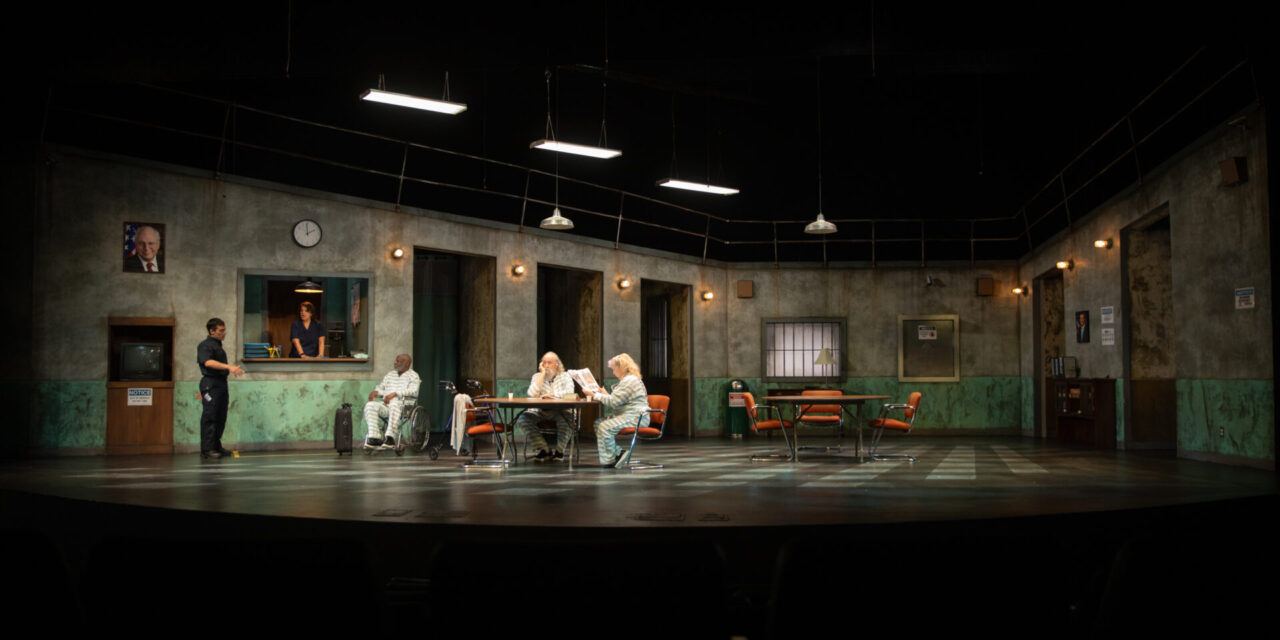
In an ironic choice from the vantage of today, the U.S. president in the story is Dick Cheney: his portrait prominently displayed onstage. When the newest resident, Joe, is being oriented, he says, “Dick Cheney? I thought he died.” “He did,” Nurse Claudia answers, “They brought him back.” The audience’s laugh, possibly remembering rumors about Cheney’s 2012 heart transplant, was at least half groan.
The choice of Cheney, who actually did die Nov. 3 of this year, effectively established a creepy but nostalgic “conservative” feel. Cheney in 2014 still was connected with impervious ruthlessness – a reputation blunted toward the end of his life by a turn against the present occupier of the White House whose administration is slashing health care and sending immigrants to El Salvador without due process.
Called Senior Provision Act (SPA) Facility #273, the bleak assisted living complex has a stark, caged feel — in fact, we learn it was a penitentiary turned elder-care unit. The parallels continue with the cast showing up in shapeless, identical striped prison garb and in several scenes, they emerge from cell-like openings in the wall.
The stories of how they arrived at SPA #273 seem involuntary. Joe, the new resident, tells a story that sounds grimly familiar: “I was mugged, fought back, fell, broke my hip, surgery, infection, allergic reaction to wrong medication, ICU, then here. My condo was auctioned off to pay the bill.”
Where did the prisoners go? Joe asks. “They were outsourced to Pakistan,” Nurse Claudia flatly responds, yet another startling prescience.
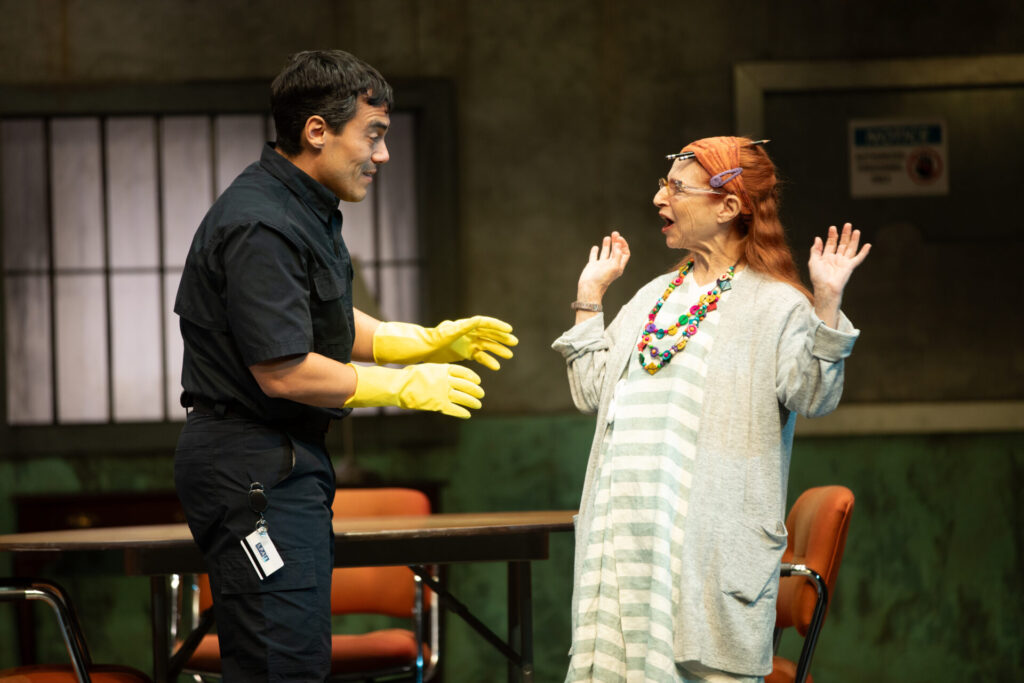
Making his Flint Rep debut as Kevin, the orderly with a past, is Christopher Eastland, originally from Texas. His exuberant overacting provides enjoyable foolishness and poignant plot support as he sides with the residents and from a good heart becomes unhinged.
Nurse Claudia, the not-quite-Nurse Rached, is played with unnerving bureaucratic monotones by Toni Rae Salmi.
The four residents are Joe Taylor, played with civilized compassion by Rico Bruce Wade; the plucky Mitzi Kramer, played endearingly by Linda Robin Hammell, also making her Flint Rep debut; Beatrice “Judy” Hart, played with lowkey normality by Jennifer Little; and the curmudgeonly Wally Carmichael, played with hilarious authenticity by Flint’s beloved Michael Kelly.
While the play clearly argues about the evils of the dystopia it depicts, it also offers competing suggestions. Even the resolutely unsympathetic Nurse Claudia gets to make a case against the residents’ complaints.
In fact, she blames the residents, all apparently Baby Boomers, for their woes and why they ended up at SPA #273 on the taxpayers’ dole.
“We’re all miserable, Mr. Taylor,” Nurse Claudia says. “At the end of my shift all I want to do is curl up with a bottle of merlot and watch crap TV until I lose consciousness. But I don’t.”
In my view the show lost momentum in the second half – moving from darkly comedic to simply comic with a side of slapstick. This is not a reflection on the performances, which were sharp, intuitive, and tightly delivered throughout. The ensemble was a pleasure to watch.
But after what felt like a buildup of tension at the end of the first act, the second act opens with an extended conversation about, let’s call it, self-pleasuring.
It is a hilarious turn, a sly but premature relief by the playwright, and suggestive of the play’s allusive underbuild: Wally describes how, waiting for his turn onstage as a Nazi during a summer stock of “The Diary of Anne Frank,” he got so aroused when a wardrobe girl bent over a pile of electrical cords that he left his spot to “heil Hitler” in the dressing room. He missed his entrance, the curtain came down, and “Anne Frank lives!” If only.
So dramatically, Forgette made an interesting choice. Without giving anything away, it was as if she lost her nerve, backing away from the worst possibilities set up in the first half.
Still, what does emerge in the second act is performances by the residents in their little “show” of excerpts of literature they know by heart – words that support their personhood with fascism-defying loveliness. When Kelly’s Wally stepped into the spotlight to recite Hamlet’s “To be, or not to be” soliloquy, the effect is breathtaking, coming not just from the character but from Kelly’s own deep-rooted experience.
The play introduces and negotiates with several relevant themes: the abandonment and abuses of the elderly by a dystopian bureaucracy; questions of individual responsibility; the healing powers of personal stories and the arts; and ultimately, the hope of the resilience of the human spirit, individually and collectively, over authoritarianism and dystopia.
Asked about the seemingly non-coincidental parallels between the play and current events, Nicole Samsel, the Rep’s interim artistic director and the person who selected “Facility” for this season, said, “The choice was made around December 2024. I have to admit, while many of the systems focused on in the world of the play have been part of our discourse for a long time, it has been interesting watching for the past year as the story has become more and more relevant by the day.”
Certainly, the timing for such considerations is right. Can we overcome the despots, the threats to our humanity? The playwright has stacked her deck in that hope, and in an era when the dystopia has become too close for comfort, we, too, desperately hope our facility for living will pull us through.






You must be logged in to post a comment.