By Kate Stockrahm
Despite a unanimous vote earlier this month, the final design of Flint’s former Central High School and Whittier Classical Academy campus may not be so final.
At the tail end of an over four-hour long meeting last night — which had already covered building concerns at Southwestern and Northwestern, the selection of Clark Construction as the construction manager agency (CM-A) for the Central project, and the school district’s financial audit — Flint Board of Education (FBOE) Trustee Dylan Luna surprised the room.
“I make a motion to consider option one for the high school design,” Luna said, referring to a design called “Scenario One” in agenda documents from the Dec. 3 special meeting in which the FBOE approved a different design option for the former Flint Central and Whittier campus.
Luna’s motion was seconded by Trustee Melody Relerford before Board President Dr. Joyce Ellis-McNeal responded.
“There’s a motion on the floor,” Ellis-McNeal said, as some Board members appeared visibly shocked. “We normally don’t do this. But — we agreed that we don’t do motion in comments. We agreed that. So what is the pleasure of the board?”
After FBOE Vice President Laura MacIntyre noted her concern over proper motion process and other trustees asked for clarification on whether the ask was really to “reconsider” rather than “consider” the Scenario One design, the Board did discuss the motion heatedly before Luna ultimately withdrew it and said he’d instead call a special meeting on the matter.
Public Comments
Luna’s motion followed a lengthy public comment portion of the Dec. 17 meeting dominated by residents voicing their displeasure with the Board’s final design decision for Central and the process by which they came to it.
One Flint Community Schools (FCS) parent, Ezekiel Harris, said he moved back to Flint with his family because he believes in the city and that its kids “deserve a school that reflects both opportunity and pride.”
“Preserving Central is part of investing in the community our children are to grow up in,” Harris said. “This is our only real chance to preserve a historic building that defines Flint’s identity. So many districts build new schools that all look the same … Central gives Flint something unique, something that no other district can replicate. Scenario One doesn’t just renovate a school, it differentiates Flint. It sets us apart in a way that no new generic building ever could. Choosing Scenario One sends a clear message to our students: your history matters, your city matters, and you are worth this investment.”
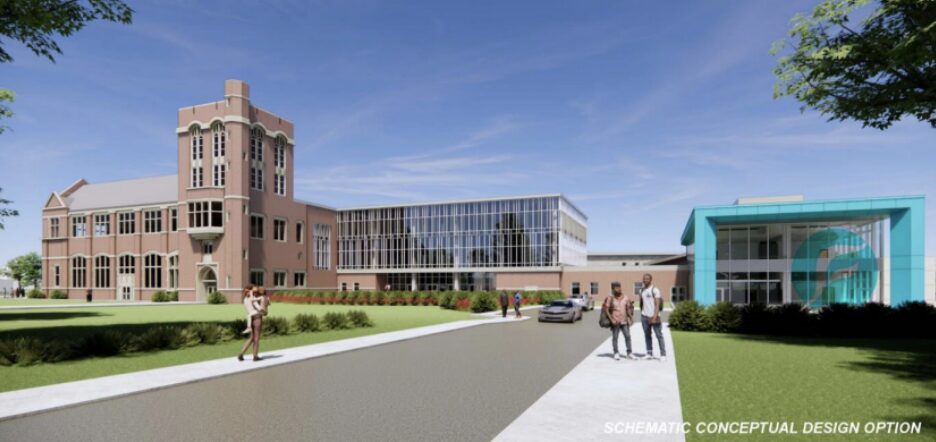
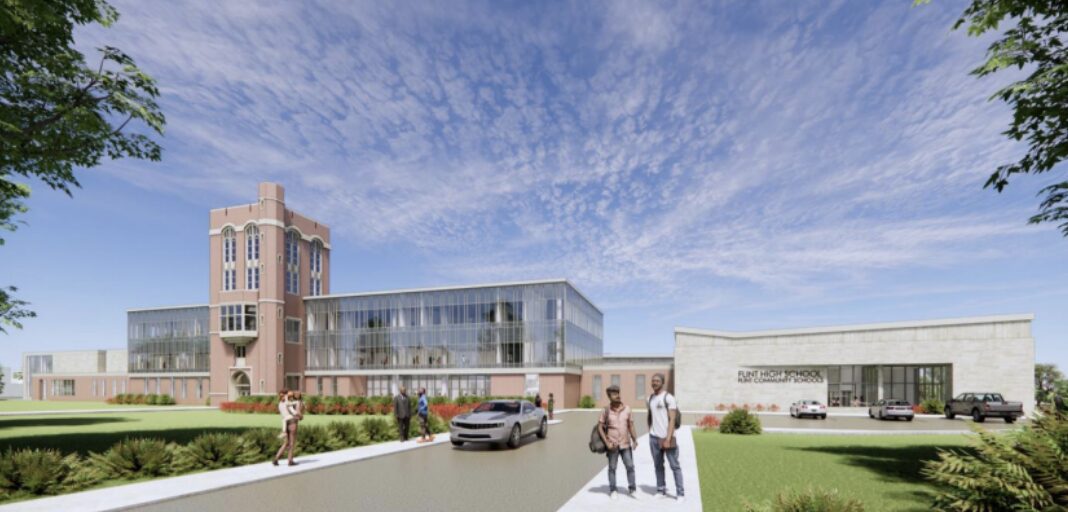
Scenario One, a design that another commenter pointed out was not made public ahead of the Board’s Dec. 3 vote, features the current high school building’s tower structure along with a large portion of its northern façade. It also includes a “Cube” structure for community space on its south side, which another commenter later suggested was not necessary given Central’s proximity to the public library and could be cut to save costs.
The Board’s chosen design, called “Scenario Two” in meeting documents, still keeps the tower but replaces much of the façade with modern glass windows.
Flint resident Phyllis Sykes introduced herself as both a proud alumnus of Flint Central and a current neighbor to its long-vacant campus. She nodded to the concerns over a lack of preservation effort in the chosen design, but said her issue was instead with the decision process.
“I attended the Central Park Neighborhood Association [meeting], where several of you were in attendance,” Sykes said, looking at the Board members while adding that she her neighbors were “under the impression” the final design decision would include “much more” community engagement.
“The understanding was that you would get input from all three presiding neighborhoods. You would go back to your table, do the numbers, take into consideration what was suggested, and would present us with another final draft,” she said, referring to the three neighborhoods surrounding Central’s campus: Central Park, Fairfield Village, and College Cultural. “And I was stunned to learn that that didn’t happen.”
“I truly believe if you destroy this building, we will regret it.”
– Racine Jackson, Fairfield Village Neighborhood Resident
Other commenters on the Central design noted that property values tend to be higher in historic areas and taxpayer stability would help the district’s finances, an architect noted that a “schematic design” means there’s still time to adjust it, a parent shared his belief that more preservation would result in greater future enrollment, and another resident repeated concerns about the way the final design vote was handled after initially promising neighbors more discussion.
“I was also at a meeting where some of the individuals came and showed us the design,” said Fairfield Village neighborhood resident Racine Jackson, adding that she’d been shown a version without the tower altogether. “I’m going to say to you what I said to them: there is not a brick out of place in Flint Central. Not a brick. It is solid, and it has been solid for many, many, many, many, many years. That means something. I know that you’ve already decided what you plan to do, but I truly believe if you destroy this building, we will regret it.”
Board Response
When it was time for individual Board comments at the end of the marathon meeting, most trustees did acknowledge the disappointment commenters had expressed, but added that it had been a decision in the best interest of students and the district’s finances.
“We have heard a lot. And I heard from all the parents, but what we have not heard [is that] this district is still in trouble. In two years, we will be broke,” said FBOE President Ellis-McNeal. “In order to get this financial stuff up, we’re gonna have to look at enrollment. We’re also looking at the financial side, looking at contract auditing, different types of programs and stuff. It’s imperative. We hear you, but we’re on a deadline. The reason we did this school? We are in a deadline. 2028 we trying to get a school, and we can’t even get 3,000 kids in it. And we cannot risk any more money. We voted for option two. It’s not a bad option. It’s not the end of the world.”
The meeting then seemed set to close after a video was shown of FCS Superintendent Kevelin Jones’ comments to the Michigan House Appropriations Committee regarding its massive cut to funding for Flint children affected by the water crisis. Instead, Treasurer Luna put forward his motion.
He quickly clarified that he felt the Board should consider Scenario One with the idea that the cube portion could still be cut from the design to save money.
“So without that cube in option one, there’s a cost difference of $3.2 million,” Luna said. “Where it brings both Scenarios [One and Two] to be on parity when it comes to how much they cost, if that makes sense.” (Agenda documents from the Dec. 3 meeting show a roughly $5.8 million difference between the two design options as presented, with Scenario One being the more expensive option.)
Trustee Relerford, who had seconded Luna, added: “I believe that when the public talks, you should listen. It’s not going to hurt anything to consider it.”
“My concern is that we voted for one of the schemes. This isn’t a reconsideration,” Vice President MacIntyre responded. “We’ve already voted by seven to zero, so the implications for reconsidering — it, it’s a — this would make a mess. This would make a quagmire. And I don’t think it’s really appropriate, like at almost 10:30 at night, to drop a bomb like this.”
MacIntyre went on to tell Luna the move was “insulting” and “a disservice to your colleagues,” though she did note that she was for historic preservation given mistakes of the past in selling off FCS assets.
Trustee Terae King, Jr. added to the dismay over the motion being called during Board comments, which he deemed a “ploy” by Luna.
“Let’s call a thing a thing,” King said. “My colleagues know we don’t normally do motion at the end of the meeting. We understand what this ploy is to say: ‘Well, whoever votes no, they’re not for preserving.’ We know what this is going to be like.”
King lamented that the motion had hurled the Board back to its old ways of name calling (MacIntyre was heard off-mic calling Luna a “dumb bastard” during another member’s comments) and offered an alternative.
“I would have entertained where, all right, ‘let’s put this on the agenda for top of the year.’ But no, we decided — my colleague decided — let’s make this motion tonight, show the community support…” King said. “Call it what it is. Please. Call it what it is. I see it. I don’t think that was the best way… I would just ask my colleague, can we just do this at the top of the year? Have the conversation, but not do this at the end of the meeting.”
Luna, who had used his discussion time to say that the FBOE “had this vote in the basement of our admin building with no cameras, very little notice, and we didn’t engage the community as we could have,” relented, but with a caveat.
“Okay, I can withdraw the motion if we give this the robust discussion it deserves,” he said, noting that such a discussion should include the school’s design team and the district’s consultant group. “I’ll tell you what. I’ll withdraw it. I’ll call a special meeting… But again, I’ve heard from several colleagues that we can discuss how to improve the design, but I want to be in public record on video that we talked about this. I withdraw.”
The Dec. 17 meeting ultimately disbanded without a vote to adjourn. The Board’s next currently scheduled meeting is on January 14, 2026.