
By Ashly Harris and Ezekiel Harris
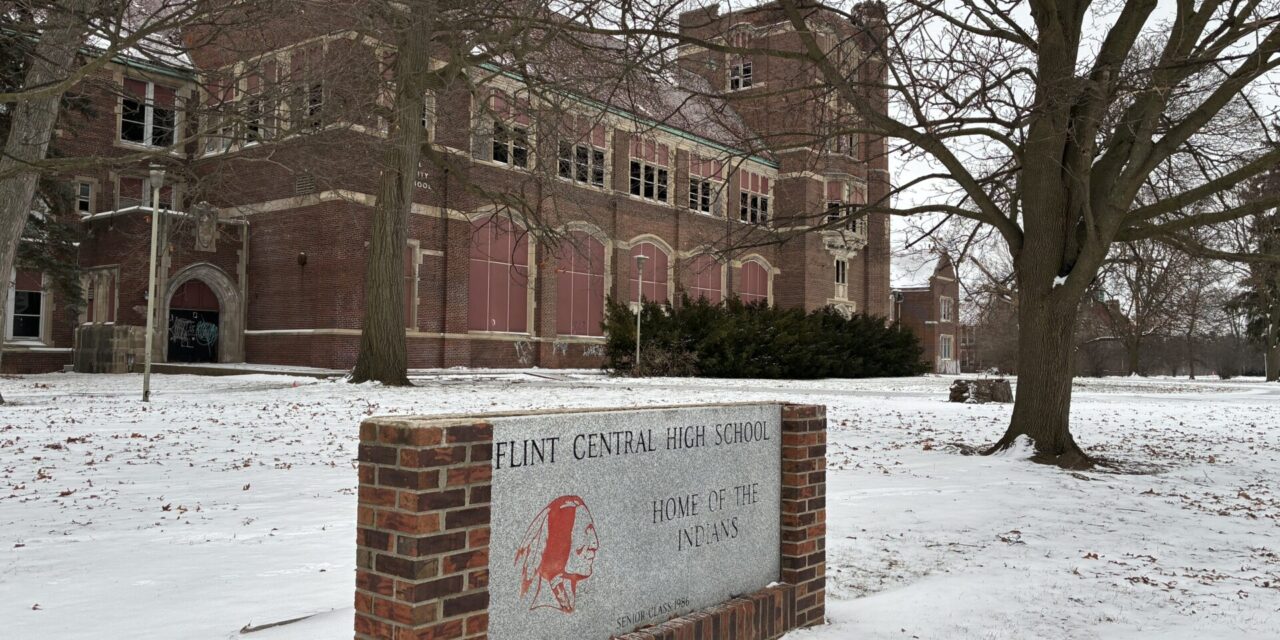
Since the closure of Flint Central High School in 2009, our community has discussed what it would take to bring this site back to life — the beating heart of a reviving public school district.
As parents of two young children in Flint Community Schools (FCS), this is something that matters deeply to us. Through fits and starts, this city is finally on the precipice of a truly transformative project, one that will build the finest high school in Genesee County in the heart of Flint. Adjacent to Mott Community College and the Flint Cultural Center, there is no better place for our city’s public high school, and much credit should go to the Flint Board of Education (FBOE) and Superintendent Jones for getting this project so close to a groundbreaking.
And yet, it appears that we may be about to make a mistake that Flint has made so many times before: seeing the only way forward as demolishing our past.
Throughout this visioning process, community voices have made it clear that preserving this historic structure is a major priority. In 2022, a resolution was presented to the Board to fully demolish Central and Whittier. At that time a coalition of community members came together to protest this proposal, and it was voted down by the board.
In 2023, 2024, and 2025 at public comment before the FBOE, community members continued to note the importance of advancing two key goals: giving Flint’s kids the best high school in our region and preserving what is arguably the city’s most historic standing structure. From neighborhood meetings to the district’s advisory committees to public comment at those Board meetings, this feedback was clear and overwhelming.
We can do two things at once. There is no tradeoff between historic preservation and top-notch educational facilities.
On December 3, 2025, the Board voted to select an option titled “Scenario 2” from a menu of proposals to redevelop Flint Central High School. Unfortunately, it was not shared publicly in advance of the meeting that a selection would be made regarding the future of the Flint Central site, as no agenda was released before the meeting was held. No video recording was or is available of that meeting, either.
However, and importantly, the four proposals presented to the Board all provided a world-class educational facility with equal amenities.
Indeed, between the scenario selected and an alternative design listed as “Scenario 1” — which preserves substantially more of Flint Central — the costs are nearly identical. Yet for some reason, the District selected an option that rather than marry the rich, irreplaceable building that is Flint Central with new, modern amenities for today’s students, demolishes almost all of the structure except for the single tower facing Crapo Street. This choice does not reflect the feedback received by the community. But, thankfully, it can be remedied easily.
Throughout Flint, we have seen a wave of historic preservation over the last 15 years that has brought historic structures back to life to serve this community in new ways.
The Durant Hotel, empty for nearly 40 years, now houses apartments and commercial spaces. Oak Street School, abandoned for decades, is now home to senior citizens. The Genesee Bank Building, also empty for decades, is now home to the Hilton Garden Inn.
We have also seen similar work outside of these downtown developments. We’ve witnessed historic preservation for new purposes at the Coolidge Park Apartments (formerly Coolidge Elementary) and the ongoing expansion and renovation of Berston Fieldhouse — another historic structure blending its history with modern amenities. Even within Flint Community Schools itself, the district completed a full renovation of Doyle-Ryder school in 2023, restoring a building with a core structure even older than Flint Central to serve modern educational needs.

So, the solution at Flint Central is simple.
The proposed Scenario 1 design preserves significantly more of this historic building than Scenario 2. It also provides the same amenities as the scenario selected by the Board, and the costs are nearly identical — yet it avoids the mistake of needlessly demolishing our past. This is the key point. We can provide a world-class educational facility and preserve our city’s history for nearly the same price as the design selected by the FBOE.
Scenario 1 would respond more directly to the community’s preferences, provide a stellar educational experience to Flint’s kids, and stand as a century-long testament to our city’s bright future. The Flint Board of Education can still call a special meeting and select Scenario 1 – this project is early enough in the process for that to be possible.
Lastly, we want to be clear that this argument is not about sentimentality for the past, or passion for some old bricks. A recent piece from the National Trust for Historic Preservation noted that property values in historic districts tend to rise more consistently than in areas that are not historic districts. In addition, many studies show that historic districts maintain their value during times of real estate devaluation — such as the 2008-2009 recession — and recover more rapidly than those not deemed historic.
For an institution that relies on property tax revenue to support our scholars, making decisions that stabilize our home values in Flint and result in more funding for student programs and success is key. Preserving Flint Central would be a wise choice that can help our school district accomplish that.
We can do this. Flint does not need to, yet again, demolish its past to move forward. Demolition does not always mean progress, and with a simple vote in favor of Scenario 1, we could be well on our way to the single finest public high school campus in Michigan being located in the heart of our city.
Ezekiel and Ashly are Flint residents and Flint Community Schools parents. Ezekiel is a social entrepreneur and nonprofit executive with more than a decade of experience in community and real estate development. His work focuses on building systems and initiatives that advance economic mobility and strengthen communities through inclusive public engagement. Ashly is a civil engineer and public sector leader with experience delivering federally funded infrastructure and community development projects in Detroit and Flint. She has led multi-million-dollar capital improvement and neighborhood revitalization efforts from planning through construction.





You must be logged in to post a comment.