By Harold C. Ford
At the March 18, 2026 meeting of the Flint Board of Education (FBOE), initiatives were launched to address the school district’s ongoing loss of students, lagging standardized test scores, and the district’s approximate 50% graduation rate.
Enrollment initiative
Ernest Steward, Flint Community Schools (FCS) Director of Student Service/Central Enrollment, unveiled an enrollment initiative for FBOE members. “Our goal is to strengthen enrollment and retention districtwide,” he said.
Steward presented a multipronged approach toward “retaining current families we already have in our district, preventing scholar withdrawal, and engaging former families.”
He said “creating a positive school culture” is the first step, as “one of the major reasons [students] want to leave the district is due to the school culture.”
Toward the goal of improving that culture, Steward intends to ramp up the use of Positive Behavioral Interventions and Supports (PBIS) and Multi-Tiered System of Supports (MTSS) already in use by the school district.
According to the Center on PBIS website, PBIS framework teaches “positive behavior, reducing disruptions … fostering a safe, supportive school climate,” and the Michigan Department of Education (MDE) explains MTSS as a proactive strategy that provides academic, behavioral, and social-emotional support to all students.
Steward said a second strategy is “family-centered enrollment” that would allow siblings, if possible, to enroll in the same school. “Most of our families, they don’t want to go to multiple schools,” Steward said. “They want [their youngsters] to go to just one building.”
A third strategy is “intentional family engagement,” Steward continued. “We have to get our families more involved in our students’ education.”
Steward then articulated a fourth strategy: targeted family support. “Work on removing barriers and providing additional resources,” he said, adding that “we need to go that extra mile” and the district’s buildings “must be welcoming.”
“We have not been good at telling our story,” Steward said. “Increasing enrollment is centered around marketing and messaging.”
“People leave districts because they think their kids can get better [elsewhere],” responded Melody Relerford, FBOE trustee. “They’re frustrated, they don’t feel heard, they don’t feel safe.”
Steward agreed, saying, “We have a lot of behavioral issues in the district.”
Current FCS enrollment is 2,525 students. East Village Magazine recently reported that about 80 percent of students that live in Flint do not enroll in FCS schools, and each of those students takes about $10,000 in state aid to other school choices. Flint is now the eighth largest school system in Genesee County.
At the conclusion of Steward’s presentation, the FBOE approved $52,000 to support Steward’s enrollment initiative by a vote of 5 to 1. Relerford cast the dissenting vote.
Graduation initiative
A graduation initiative was presented to FBOE members by Kelly Fields, FCS director of academics, and Tracy Davis, an education consultant.
Fields and Davis said they intend to work from the bottom up starting with the class of 2038, those students who are currently enrolled in the district’s kindergarten program. They said they envision “building a graduation culture where every student knows they can achieve to make it to the threshold of [high school] graduation.
Key components will include development of literacy skills, building social-emotional readiness, instilling a value of accountability, public relations campaigns, and supports for students at risk.
The initiative will also take aim at the class of 2029 – the critical 9th grade or freshman class – where students start the final march toward high school graduation or dropping out. (Fields called it the “freshman slide.”) The district will endeavor to build resilience in those 9th graders.
Credit recovery opportunities will also be expanded and promoted, the pair said, and adult and peer interventions will assist those in need.
Less traditional strategies include: “monthly marches [during which] students can become familiar with what graduation and celebration feels like;” kindergarten summits to reduce “some of the behaviors that have plagued kindergartners across the district;” “future silhouettes” in which students artistically envision what they might look like on graduation day; and a “signature wall” ceremony during which students publicly commit themselves to graduate.
Other strategies noted were a “goal-keeping sheet,” “commitment brunches,” and a campaign to increase support for students from parents, school personnel, and others.
FCS-watchers will note that the strategies articulated by Fields and Davis are consistent with the 2022-2027 Strategic Plan posted at the district’s website. Three of five of the plan’s “strategic priorities” were represented in their proposed graduation initiative.
- Strategic priority #2: “The district has expectations for high levels of teaching and learning in an environment that supports … continuous improvement.”
- Strategic priority #3: “The district will build and promote a culture and climate of excellence that is conducive to high levels of teaching and learning.”
- Strategic priority #5: “The district will align all fiscal resources to support high levels of teaching and learning.”
Assessment data
Finally, Fields led a lengthy review of recent assessment data provided by the state’s education department. She noted that assessments are “a precursor to the next partnership agreement” with MDE. (FCS is but one of 44 low performing districts in the state partnering with the MDE toward the goal of improvement.)
During her discussion, Fields touched on a few nuggets of positive data.
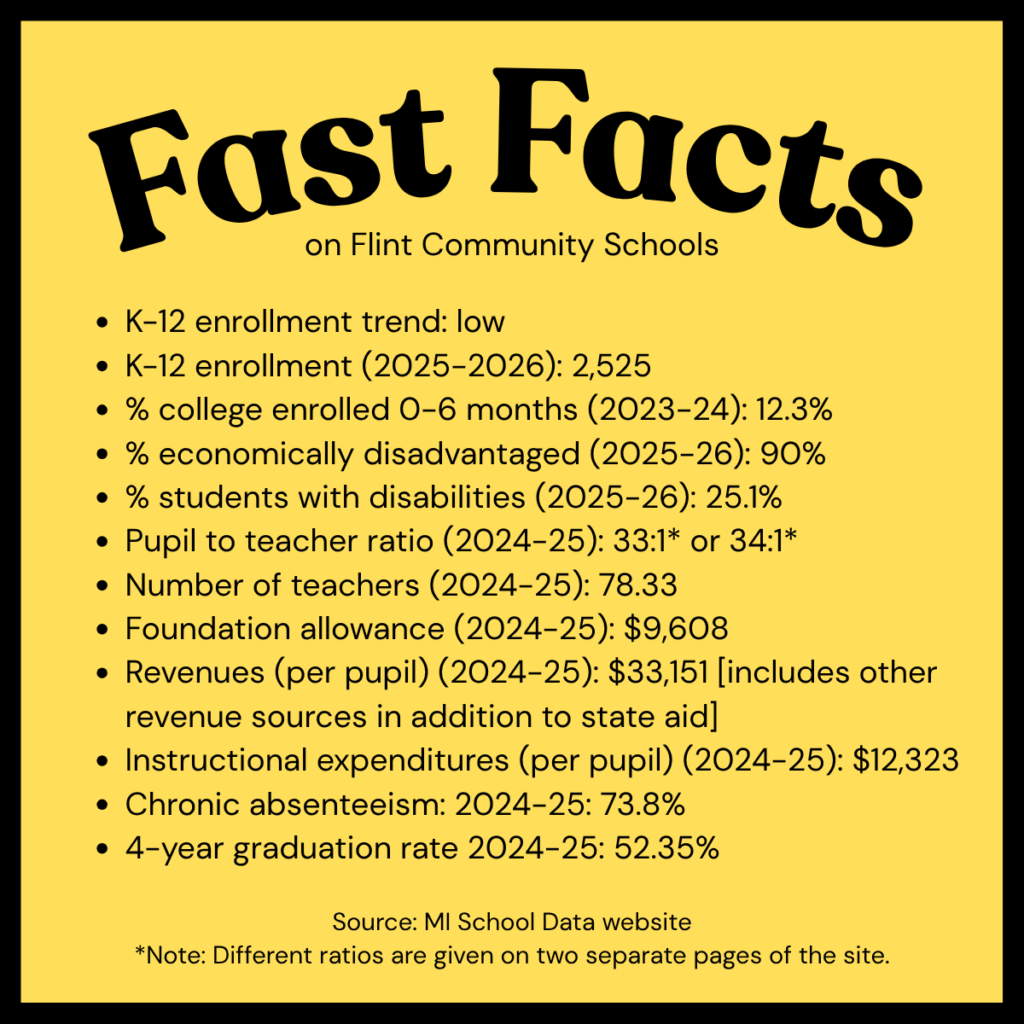
The district’s 52.3% graduation rate in the 2024-25 academic year was a 4% improvement for FCS. A 78.25% attendance rate was also a 4.41% improvement over last year’s 73.84%. “We’re increasing attendance and decreasing chronic absenteeism,” Fields noted.
She also highlighted some academic improvements for the district.
“There’s celebration in order for Eisenhower,” Fields said. “They did a fantastic job of raising scores.” She lauded Accelerated Learning Academy’s 6.7% increase in math proficiency, and she also cited improvement at Neithercut Elementary even though the building is now closed.
Nonetheless, Trustee Laura MacIntyre judged the report on student assessments as “sobering” and “hard to look at.”
Below is a listing of 2024-25 FCS assessment data* through 8th grade that EVM pulled from the MI School Data website.
M-STEP English Language Arts:
- 3rd grade: 259 students assessed; 14 advanced or proficient; 41 partially proficient; 204 not proficient
- 4th grade: 191 students assessed; 12 advanced or proficient; 17 partially proficient; 162 not proficient
- 5th grade: 237 students assessed; 27 advanced or proficient; 31 partially proficient; 179 not proficient
- 6th grade: 206 students assessed; 29 advanced or proficient; 43 partially proficient; 134 not proficient
- 7th grade: 99 students assessed; 7 advanced or proficient; 10 partially proficient; 82 not proficient
- 8th grade: 109 students assessed; 17 advanced or proficient; 15 partially proficient; 77 not proficient
M-STEP Math, includes PSAT data:
- 3rd grade: 260 students assessed; 18 advanced or proficient; 46 partially proficient; 196 not proficient
- 4th grade: 194 students assessed; 4 advanced or proficient; 34 partially proficient; 156 not proficient
- 5th grade: 239 students assessed; 6 advanced or proficient; 33 partially proficient; 200 not proficient
- 6th grade: 207 students assessed; 8 advanced or proficient; 36 partially proficient; 163 not proficient
- 7th grade: 98 students assessed; <3 advanced or proficient; (no additional data at MI School Data site)
- 8th grade: 109 students assessed; <3 advanced or proficient (no additional data at MI School Data site)
Science, includes PSAT data:
- 5th grade: 231 students assessed; <10 advanced or proficient; 215 partially or not proficient
- 8th grade: 118 students assessed; <10 advanced or proficient; 110 students partially or not proficient
Social Studies, includes PSAT data:
- 5th grade: 237 students assessed; <10 advanced or proficient; 229 partially or not proficient
- 8th grade: 115 students assessed; <10 advanced or proficient; 107 partially or not proficient
English, includes PSAT data:
- 8th grade: 109 students assessed; 17 advanced or proficient; 15 partially proficient; 77 not proficient
*Note: Data at various spots on the MI School Data site do not always agree.
* * * * *
Future FBOE meetings are scheduled for: April 15; May 13 & 20; and June 17. Meetings typically start at 6:30 p.m. and can be streamed on the district’s YouTube page.
Editor’s Note: A version of this article also ran in the April 2026 print edition of East Village Magazine. This version includes additional PSAT data for science, social studies, and English.