By Gordon Young
There are some travel guides you want beside you on the car seat. Remember the old AAA TripTik? It still exists, though in a more practical but less satisfying digital form. The dashboard touchscreen display is just not the same as flipping the pages as the miles roll by on a road trip.
But other guides are more at home on your front porch on a summer afternoon or beside your favorite living room chair. They won’t provide any great hotel options. Instead, they capture the mood, feel, and history of a place. You’ll have a deeper understanding of the region when you finish, even if you never leave the house.
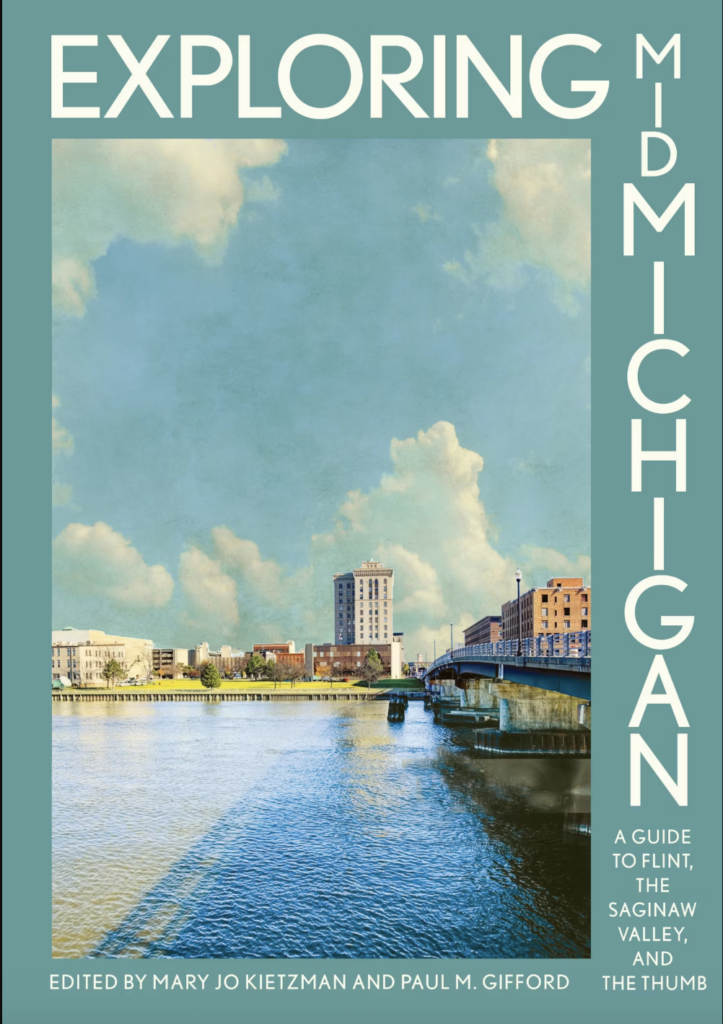
“Exploring Mid-Michigan: A Guide to Flint, the Saginaw Valley, and the Thumb” is an ambitious effort that racks up more than 400 pages. It mixes and mingles a traditional travel guide with in-depth ethnography, geography, and literary essays, along with a smattering of poetry, photos, and drawings. It’s an encyclopedia of Mid-Michigan vibes that invites you to jump from topic to topic in no particular order.
Edited by Mary Jo Kietzman, a UM-Flint English professor, and Paul M. Gifford, a former archivist at the university, it is modeled on the incredible state guides produced by the Federal Writers’ Project (FWP) in the 1930s. That New Deal project put to work thousands of unemployed journalists, writers, librarians, teachers and editors during the Great Depression to create a roadmap of “the nation’s social and cultural landscape,” according to historian David A. Taylor.
John Steinbeck called the original guides “the most comprehensive account of the United States ever got together, and nothing since has even approached it.”
In that spirit, “Exploring Mid-Michigan” relies on nearly 30 contributors to cover everything from the racial dynamics of the Flint Water Crisis to the chicken dinners at Zehnder’s in Frankenmuth. An essay on the archeology of the area is followed by a profile of the Golden Leaf, one of the oldest Black-owned clubs in the country. A profile of James Stevens and his Paul Bunyan stories shares space with Philip Levine’s poetry:
These are the children of Flint, their fathers
work at the spark plug factory or truck
bottled water in five-gallon sea-blue jugs
to the widows of the suburbs.
The list of past, present, and future cultural components detailed in “Exploring Mid-Michigan” could seemingly go on forever. And that may be the point. Anyone with a real connection to Flint and mid-Michigan has no doubt grown weary of the drive-by press coverage over the years, chronicling the all-too-real tragedy but somehow failing to capture the optimism, grit and, yes, humor of the place. Without too much boosterism, this opinionated guide highlights some of the reasons people still want to live here, and why so many who have left still consider it home.
Gordon Young is a journalist whose work has appeared in the New York Times, Politico, and Slate. He is the author of “Teardown: Memoir of a Vanishing City” about the past, present and future of Flint and cities like it.
Editor’s Note: Multiple East Village Magazine writers submitted work for “Exploring Mid-Michigan” including Paul Rozycki and Harold Ford. This article first appeared in East Village Magazine’s August 2026 print edition.