
By Kate Stockrahm
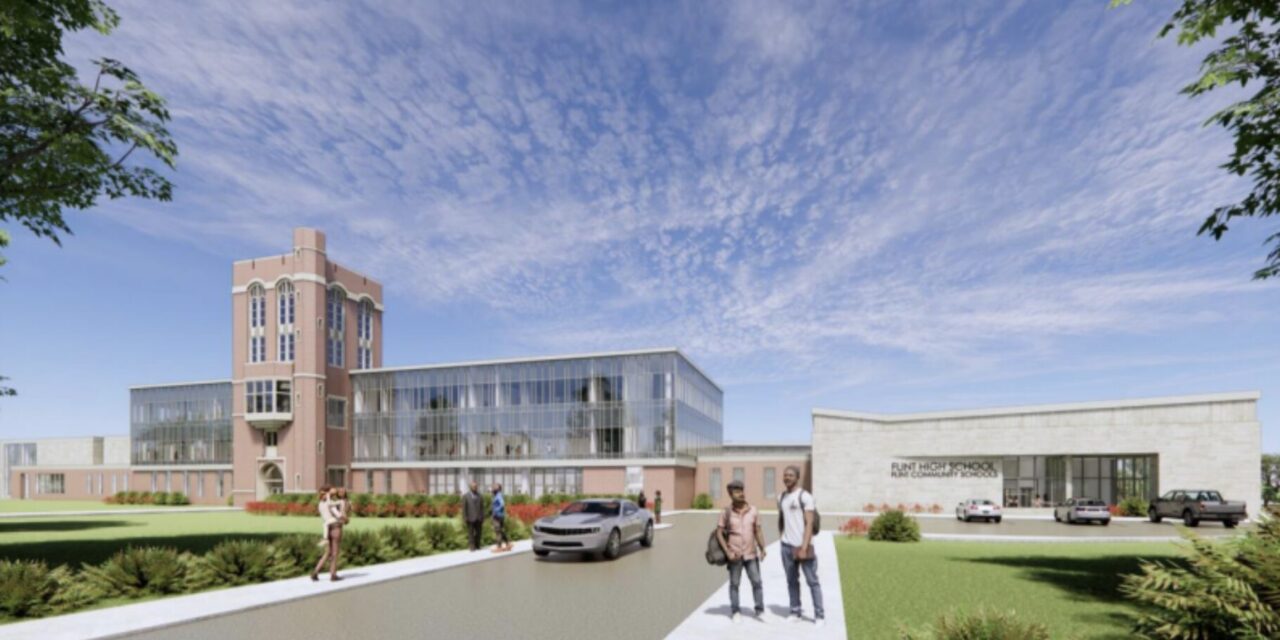
Last night, the Flint Community Schools Board of Education (FBOE) voted unanimously to approve a design for a new high school on the site of the former Central-Whittier campus, slated to open in fall 2028.
“It’s an exciting moment,” Board President Dr. Joyce Ellis-McNeal told East Village Magazine on Dec. 4, nearly a year after the Board approved a contract with Plante Moran Realpointe to help plan for the campus’s upgrade and reopening.
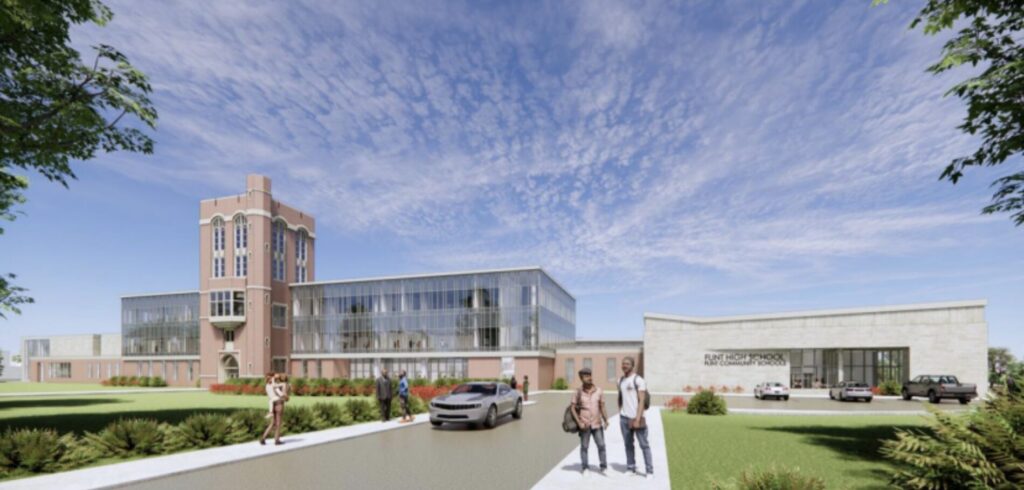
Ellis-McNeal explained that the chosen design – which features the current Central High School’s large tower amid gleaming glass walls and a modern entrance to the south of the campus – blends the district’s desire to spend its limited finances thoughtfully while still incorporating the community’s feedback and, most importantly, focusing on student success and academics.
“Yes, we are building a new school, but also we are building an academic curriculum to meet [students and parents] where we failed in the past,” she said. “We want parents to trust Flint again – trust us again.”
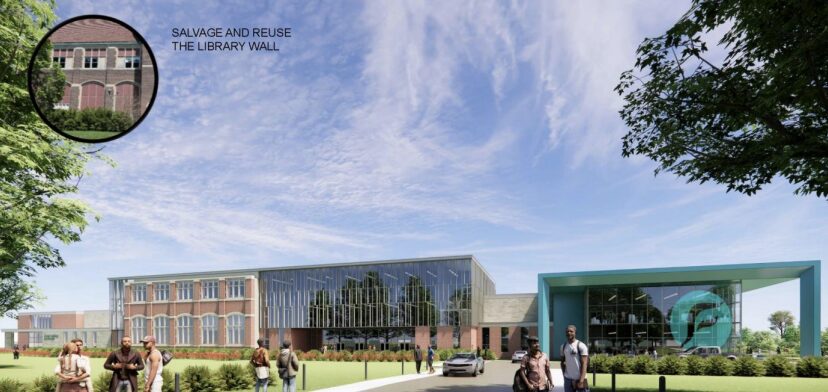
That feedback had largely focused on better preservation efforts of the century-old Central High School, as an initial design plan presented in September suggested demolishing the whole of the current campus, adding a cube like the one at the recently-renovated Brownell-Holmes campus on Flint’s north side, and keeping only the high school building’s front entryway and rebuilding part of the new school’s façade with salvaged bricks from the demo.
“I know there’s a lot of work that’s been put into getting to this point, and I don’t take that for granted,” said Samantha Farah during public comment at an Oct. 8 FBOE meeting. “While the recently presented plans acknowledge the community’s desire for preservation, I do believe they missed the mark, and that this board would be missing the opportunity to not just preserve a wall or a singular feature, but to protect one of the few standing institutions that represent the rich cultural heritage of our community.”
Farah, a third-generation Central High School graduate that wore her old Central varsity jacket to the meeting, noted that she didn’t believe that preservation came “at the expense of student learning.” She cited examples of old buildings that have been restored and renovated for students already in Flint, such as Michigan School for the Deaf and Powers Catholic High School.
“But my tax dollars aren’t supporting Powers Catholic High School. They’re supporting this one – in a building that I love, in a city that I love. And once those walls come down, they cannot be rebuilt,” she concluded. “You have the opportunity and the responsibility to demand more from the planning team, to offer us solutions that don’t just incorporate a historic feature here or there, just to say they did it, but to protect the cultural institution for our students, first and foremost, but also for our entire city now and for generations to come.”
When asked about the feedback the Board had received since the initial design presentation, feedback which was also gathered at multiple meetings with neighborhood groups located around the campus, Ellis-McNeal said that the Board had done its best to listen but also to lead.
“We had to get in the mindset: who are we serving?” Ellis-McNeal said. “We’re not just serving one group. We serve the entire community. Flint High School is for the Flint community.”
She also stressed the budgetary constraints of the project, and that at the end of the day, the Board’s decision was about Flint students first. “We have money for building, but the most important thing is meeting academic [needs] – to have an academic curriculum right for the kids.”
The design vote was taken at a special meeting on Dec. 3, and while it was unanimous, some Board members later shared that they would’ve liked to see more preservation work and public engagement.
In a Dec. 4 Facebook post, FBOE Treasurer Dylan Luna wrote: “Let me be clear: this is a win for Flint kids, for our community, and for the long-term success of our city.”
He said that he had “strongly advocated for greater historic preservation and more robust public engagement,” but ultimately thanked many who brought the Dec. 3 vote to fruition, including his colleagues on the Board and financial supporters like the Mott Foundation, which announced today another $5.3 million to support design work and demolition at the site.
“There is still a great deal of work ahead—and meaningful, proactive civic engagement must remain at the center of that process,” wrote Luna. “Together, we can build a high school that honors our past and invests in our future.”
According to documents presented at last night’s meeting, the selected design will cost around $134,214,000 – the least costly of the four proposed design scenarios – though documents note that “detailed structural and historical analysis will be required and could increase costs.”
The plan turns the current high school’s tower into “learning spaces” and includes a new gym, “athletics,” and the FCS administration. McNeal told EVM that the Flint Center for Educational Excellence, which supports the district’s after-school programming, will also be onsite.
Per a Dec. 4 press release from the Mott Foundation, demolition work on the campus should begin in April 2026.







You must be logged in to post a comment.