By Nathan Waters
Data centers are one of the hottest and most contentious topics in the current discourse across Michigan and the United States at large. The requirements for digital storage and increased development of online services by big tech companies like Meta (parent company of Facebook), Microsoft, and Google are driving the boom to build data centers further afield – and nearer to home.
With potential data center site plan reviews, permits, and facility installations in Flint halted by a 12-month moratorium passed by city council in June, it seems time for East Village Magazine (EVM) to provide an overview of the landscape surrounding these controversial developments in Flint and beyond.
What are data centers?
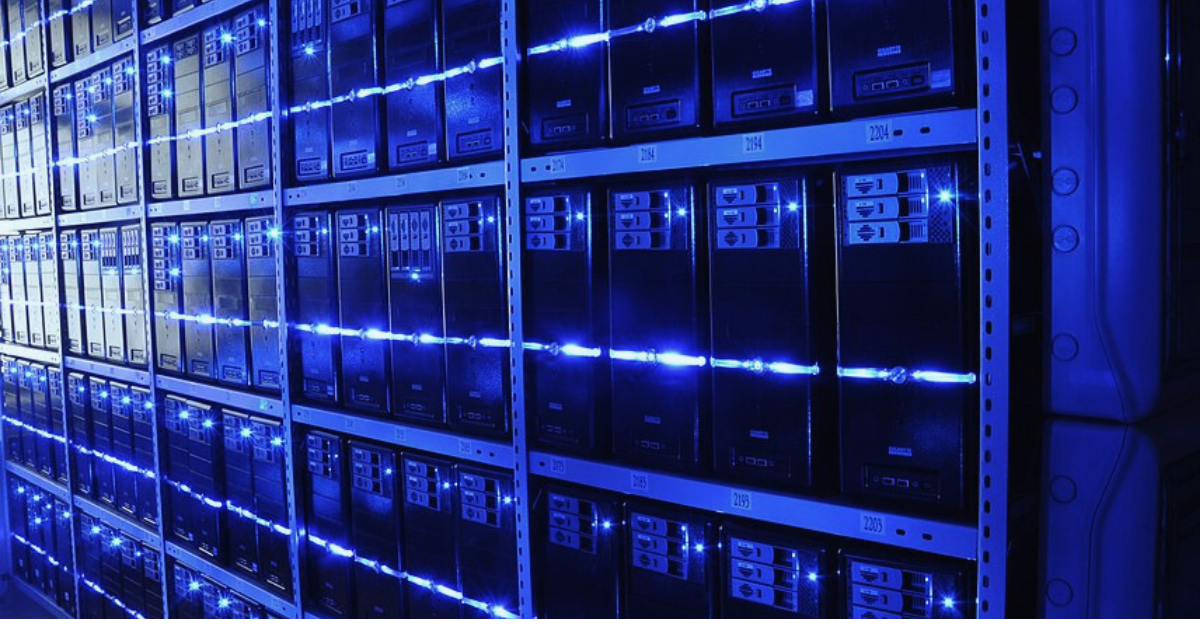
A data center, at the basest level, is storage space for large quantities of computers called servers, which are essentially more powerful versions of computers similar to what would be available to everyday consumers. Both have the same basic components – such as a motherboard, central processing unit (CPU), random access memory (RAM), and connections to power and a network – but the key difference between a home computer and a server is that a server has no “interface peripherals” like a screen, keyboard, or mouse.
A server does not require a typical interface as the information it provides is shared through a network, typically the internet. When an external computer requests information held on a server, the server receives a request to “serve” the information to the requesting computer – hence the name “server.”
“Most people just understand data centers as just the structure,” Dr. Changxin Bai, assistant professor of the Computer Science Department at Kettering University, told EVM, “but it is all of the infrastructure, chips, cooling, network connection.”
The size of a data center is described by how much power the facility consumes at “peak load,” which is measured in mega-watts (MW) or giga-watts (GW). This is the amount of power used in an instant while the facility is running at full capacity.
Dr. Bai explains, “Electricity is the main infrastructure [of a data center], but it is not just the electricity used by the chips. [There] is the usage of the server, the storage, the networking and the cooling.”
Data centers can also vary widely in physical size, from “a network closet or a warehouse holding servers” to a “multi-location campus” comprising multiple warehouses.
Though the average data center is between five to 10 MW according to the American Society of Mechanical Engineers (ASME), for simplicity’s sake, let’s consider a one MW data center, meaning a data center that uses one mega-watt of power in one hour (MWh).
The average American home used about 0.9 MWh per month in 2022 according to the U.S. Energy Information Administration, and by comparison, a one MW data center running full-time would use 730 MWh over that same time period.
Data center growth
According to recent reporting by the Pew Research Center, nearly 1,500 new data centers are being planned or under various stages of development across the United States. At the time of publishing, there were 79 data centers in Michigan, according to the industry research site Data Center Map. But what is causing this data center boom, and why are they spread out across the country?
The tech industry’s push for data centers has largely been fueled by the implementation of AI into just about every product, with major companies and start-ups alike creating their own AI models. Giant companies such as Google, Microsoft, and xAI have Gemini, CoPilot, and Grok respectively, while startups such as OpenAI and Anthropic have produced ChatGPT and Claude.
All of these programs are what are called Large Language Models (LLM). Such programs take a large amount of data to “teach” the AI how to respond. Teaching, in this instance, isn’t similar to how a human being is taught. LLMs use a massive number of data points, or parameters, numbering in the billions to greater than one trillion, to make each piece of feedback. These parameters are processed using a method called matrix multiplication to provide the statistically most-likely next word in the model’s response.
The many calculations needed for response to every inquiry (at a speed that’s appealing to a user) currently requires many processing units to divide those calculations into smaller portions. The method needs enormous amounts of power, and therefore the data centers that make those calculations possible use an enormous amount of power.
As reported by the Massachusetts Institute of Technology (MIT) Technology Review, it is estimated to have taken 50GWh, or 50,000 MWh, just to train OpenAI’s Chat GPT-4. This equates to the power usage of approximately 4,600 average homes in a year, or about 113% of all of the solar power generated in Genesee County annually. This is before any user makes a request for information, called a “query.”
Sam Altman, OpenAI’s CEO has claimed that each query uses 0.34 watt-hours on average for the GPT-4 model, with Axios reporting that OpenAI claims to receive 2.5 billion queries per day. This equates to around 850 MWh per day of power usage, or the equivalent of 78 homes’ yearly power consumption.
Unlike other industries, which look for low-cost labor in developing nations and can ship products worldwide, the data center business requires a directly opposing approach. The requirement for reliable power and network connection combined with the requirement for rapid response to users has pushed the building of data centers into every state across the U.S. Long distance communication of the data causes delays (called latency) which are only portions of a second, but that time rapidly expands with the large amount of data being processed.
Together, all of these requirements push corporations to seek expansion into locations with low-cost land, reliable power (with the capacity to easily generate more power), and stable, high speed connection to the internet.
Environmental impact
Opponents of data centers will point to environmental and infrastructure impacts as a reason data centers should be kept out of a community. These impacts usually involve concern over land usage, water usage, and carbon emissions/pollution.
“People talk about pollution and carbon emission, but it depends on where [the power] is coming from. Oil and gas, sure,” Dr. Bai explained of possible pollution from source fuels, but “green or nuclear… maybe wind, you may have a nice [low] emission of carbon.”
While it is worth mentioning that solar, wind, and nuclear energy may have their own set of environmental concerns due to equipment manufacturing or waste disposal, most energy in the United States is generated using coal, natural gas, or oil byproducts known as “fossil fuels.” Fossil fuels are burned to create energy, they emit greenhouse gasses, chief among which is carbon dioxide (CO2), and the emission of these gasses contribute to the ongoing heating of the Earth’s atmosphere and the change in climate and patterns across the globe, according to the National Oceanic and Atmospheric Administration (NOAA).
The United States generates roughly 384g CO2 per a kWh, based on a mix of power sources including coal, natural gas, wind, solar, and nuclear, according to the United Nations University Institute for Water, Environment and Health.
While that’s below the global average of 422g CO2/kWh, the addition of 8.5 GWh (8,500 MWh) of data center compute power to the U.S. in 2025 generated 3,264 metric tons (7,165,000 lbs) of CO2 into the atmosphere – or the rough equivalent of the emissions from an additional 8 million miles driven by the average American car. This is only the newly-realized data center power, excluding what existed before 2025.
Atop carbon emissions, the electricity used by data centers is also ultimately converted to heat – and that heat needs to go somewhere, lest it melt the equipment that is making use of this power.
The cooling solutions for data centers can vary, but are typically either one or some combination of the following methods – most of which require water, more power, or both.
Mechanical cooling
Mechanical cooling is an industrial-sized version of a home air-conditioner. It requires a more open layout for a data center with wide rows between server racks to allow cold air to flow. This uses a relatively large amount of power and comparable water to other average cooling methods, on a scale of 0.7 to 3 liters per watt-hour (L/Wh).
When considering this at scale for our one MW data center example above, that data center could use between 511,000 to 2,190,000 liters (135,000 – 579,000 gallons) of water per month. A range that can be described as 20-90% of the volume of an olympic sized swimming pool.
Air cooling
Air cooling is the use of mechanical coolers, typically using some type of refrigerant, to cool the air within the facility where the humidity and cleanliness of the air can be controlled. This is the most common, and energy demanding, process.
Free air cooling
Free air cooling is a low-water and low-power option that essentially uses regular air to cool servers. By blowing outside air through a server room, or leaving it exposed to air, heat will be pulled away at the whims of nature. However, this method is limited to some of the coldest regions on earth.
Adiabatic cooling
Adiabatic cooling uses the properties of water to pull heat away from a radiator (similar to that used in mechanical cooling) and as the water evaporates, it helps pull heat from the system, thereby cooling it. This method is limited mainly to dry climates as humid climates limit the water’s ability to evaporate.
Using the numbers from the hypothetical one MW data center discussed previously, the water usage would amount to ~4,4 million gallons of water per day or more in this method.
Noting the environmental concerns surrounding data centers is not to say that they are completely not worth building, as data centers have proven an invaluable part of modern internet infrastructure. They hold the websites, records, personal information, and back-end computer work that much of the modern world uses every day. For example, in October 2025, Amazon Web Services (AWS) US-EAST-1 data center had a 15-hour outage. The outage shut down many major websites and services such as Snapchat, McDonalds App, United Airlines, and The New York Times, showing just how much of daily life is now tied to just one data center.
Data centers and Flint
On June 3, Flint City Council President Candice Mushatt introduced a resolution for a 12-month moratorium on the planning or development of new data centers within the City of Flint.
“The moratorium was introduced simply to give us time, right, to understand any environmental impacts that may happen as a result, to understand the true benefits of having it in our community, to understand the true economic benefits,” Councilwoman Mushatt told EVM. “There was just so much happening that I thought 12 months would give us time to conduct studies as well as speak with residents and just hear [their] feelings and concerns.”
When asked about how the moratorium timing will be used to help better plan out the future for Flint, Mushatt said: “Everyone needs to come to the table and have a conversation. I think EGLE (Michigan Department of Environment, Great Lakes, and Energy) needs to come and discuss how our water will be protected.”
She added that she thinks the planning “will at least begin within the month of August.”
It should be noted that Flint is already home to one data center. While not nearly on the scale of Amazon, Google, or Microsoft, OTAVA, a cloud storage and data protection services company, runs its mid-Michigan facility – a 32,500 square foot, 1.5 MW facility according to the company’s website – locally.
On June 8 Flint City Council voted in favor of the12-month data center moratorium resolution 7-1, with Fourth Ward Councilwoman Judy Preistley as the sole “no” vote.
EVM reached out to Councilwoman Priestley for this article but she declined to comment by press time.
Editor’s Note: This article first appeared in East Village Magazine’s August 2026 print edition.