By Paul Rozycki
In 1976, Flint’s population was about 160,000, General Motors employed 80,000 people in Genesee County, gas was 59 cents a gallon, and the average household income was $16,000. No one had home computers, laptops, or cell phones – and, in July of that year, Gary Custer published the first issue of East Village Magazine.
Gary Custer
Custer was the founder, publisher, and editor of East Village Magazine for 39 years, ending his tenure only when he passed away in 2015. He attended Walker Elementary and Whittier Middle School, he was a graduate of Flint Central and the University of Missouri (where he studied photojournalism), as well as a veteran of the U.S. Navy where he served in Vietnam and Japan from 1968 until 1971.
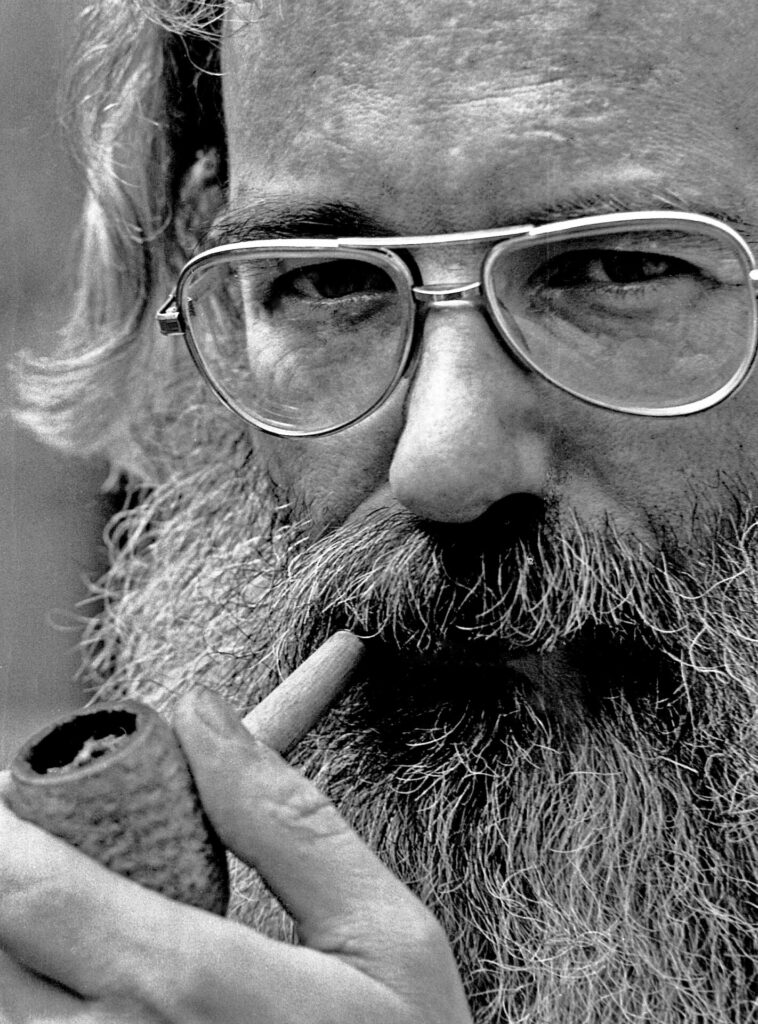
His commitment to journalism, photojournalism, and his community showed in every East Village Magazine he produced.
As quoted in a Flint Journal story from August 29, 1982, Custer said, “One of the most important factors in turning this city around is strong neighborhoods. Because without them you have no place for your people.”
EVM’s commitment to the local community has since earned the magazine two Liberty Bell Awards from the Genesee County Bar Association: Custer won in 1999, and I was honored in 2018. Many of the early causes Custer pursued were to improve the neighborhood around the magazine’s office on Second Street. Early issues of the magazine, which was offered biweekly, focused largely on neighborhood-level news and asked readers to respond to polls on what they considered important.
Custer’s commitment to good journalism was equally strong. His belief in the power of good photojournalism and the art of photography gave the magazine its iconic cover: high-impact black and white photos mostly captured by his brother, Ed Custer.
Ed said that Gary “did not like working for others and wanted to continue his high standards of journalism” – a sentiment Gary confirmed in his Flint Journal interview back in the 80s. “I’m not the least bit interested in working for a large organization,” the elder Custer explained. “I need a degree of control and I’m willing to pay the price.”
An uncertain future
When Gary passed, Jan Worth stepped up to become EVM’s editor and noted Custer’s impact on her work.
“I’ve spent some real quality time in that impossibly chaotic office on Second Street over the past eight years since I started writing the back page column for East Village Magazine,” she said at the time. “I used to go in one Sunday afternoon a month to proof my column, and Gary and I would talk about everything. It was especially enjoyable to talk about Flint – history, gossip, politics, architecture … those conversations always made me feel better about living in Flint.”
She called Custer’s aesthetic “very cool” and said the folks he left behind were committed to keeping to their founder’s values despite the doubts surrounding the future of the magazine.
“It was wrenching for many of us when Gary died in January of 2015,” she explained in a June 2026 interview. “He had just learned that EVM had been granted support from the Mott Foundation, and it finally seemed that the magazine would have a chance for some financial stability … after 39 years of being held together by Gary and Ed with paper clips and ferocious determination. Gary was passionately devoted to local journalism, uncompromisingly ethical, and produced work that honored the First Amendment and professional standards.”
She noted that a few people dedicated to Gary’s principles – including Ed and Nic Custer, Gary’s nephew – have continued to tell the story many times since.
“A group of us asked the Mott Foundation if we could keep the money and try to keep the magazine going,” she said. So, Worth took over as editor and, with help from her husband, Ted Nelson, “and a rotating band of reporters and a handful of faithful advertisers and small-dollar donors” the group kept EVM going for the next five years before another editor came aboard – and then another.
“I think a lot of us thought EVM would die with Gary,” Worth recalled. “But when it came down to it, we really didn’t want to let it go. For one thing, we loved Gary, in all his Flint-centric ways and devotions. And EVM was a sweet and fierce and idiosyncratic presence in the community, which had started the same month, the same year, as the nation’s 200th birthday. We loved that.”
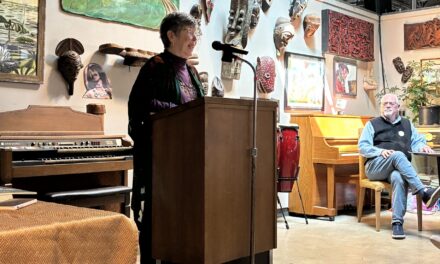
Jan Worth, EVM columnist and editor
While Worth took the reins after Gary died, she was not new to EVM at the time. She had been a Village Life columnist since 2007 – regularly sharing short essays on life in Flint. Her very first such column, “I never thought I’d stay this long,”
was republished in our 50th anniversary issue in honor of her many contributions to this publication before Gary’s passing and in the years since.
Of those Village Life stories Worth said, “Writing my columns for Gary kept me going, as a writer and as a citizen and as, well, a human being for all those years. I felt like EVM opened the doors to this community about itself, about us, about who we were.”
Worth’s essays were later gathered into a collection titled “That’s My Moon Over Court Street,” which was published three years ago.
“It was very satisfying to me to put together that collection in 2023,” she said. “I feel like those 104 essays needed to be in the world, as an artifact of what Gary started and what I continued to try to endow with my own love of writing and of the stories that kept emerging. This is what local journalism at its best means, I think, and what I hope might continue for many, many years.”
Ed Custer, EVM photographer and artist
Ed Custer has created many of the most iconic EVM cover photos over the last 50 years.
He said that some of the rewards of that work have been “the opportunity to practice my photographic art and photojournalism and reach thousands with my photos. This has been a far greater audience than any show in a gallery.”
Custer explained that with each image he wants to create “a striking cover photo which people will want to pick up, read the magazine, and keep it on the coffee table.” As an artist, he pays particular attention to the composition, tones, and visual balance of his photographs.
He said that he rarely has a particular location in mind when looking for photos for the next issue, and it’s actually with some anxiety that he hopes to discover a great shot for the cover each month.
Still, Custer said, he enjoys the challenge of trying to find fresh local material that’s seasonal with a community connection. He said “art is a thread that has run throughout my life, adding much meaning,” and his photos often became the inspiration for his paintings or chalk drawings.
While Custer has captured the great majority of EVM cover photos, over the years a number of others have also snapped the cover image for the print magazine. Gary did the cover photos up through 1979, Casey Custer, Ed’s wife, did many of the photos from April 1980 until 1984 and Tracy Redding, Mike Neithercut, Jan Worth, and former EVM editor Tom Travis have also contributed.
My own contribution
Unlike Ed or Jan, I didn’t know Gary well. I met him for the first time when Ed was having a show of his work at the Greater Flint Arts Council in 2010, and Gary approached me to do one column on local politics. We exchanged regular emails, and I thought it would be only one piece… but after 16 years I’ve enjoyed the challenge of doing a column (mostly on politics) every month since then. Working with Ed, Jan, Kate and all of the EVM staff and Board members has been one of the most rewarding parts of my retirement.
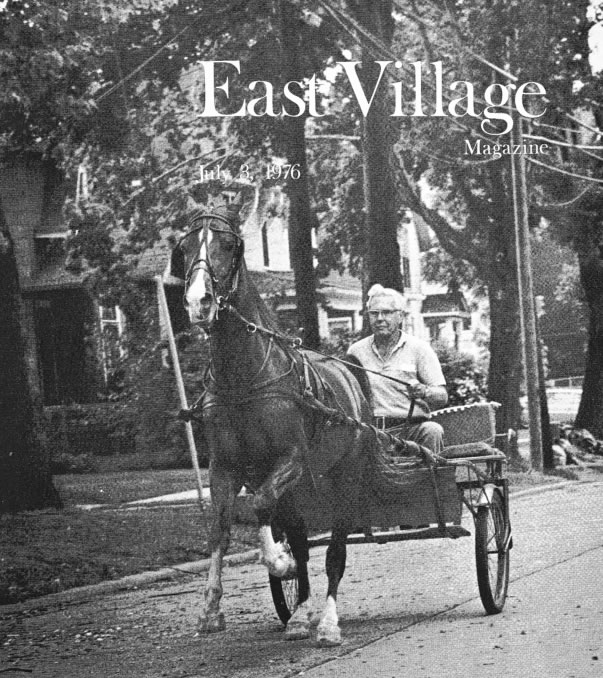
And yet, while I thought my connection to EVM was not as mature as others’, as I took a look at the very first issue of the magazine (published July 3, 1976) for this commentary, I found a connection to my first days in Flint.
One of the articles in the first issue dealt with Riverside Church expanding its parking lot across the street from the East Village office on Second Street. When my wife and I moved to Flint in 1969, our first apartment was at 711 E. Second St. – right where EVM was reporting on. We moved a few years later when the church took over the apartment building to demolish it for that parking lot. In many ways this is a full circle connection with my interests and the impact of EVM on the community.
Having worked for a newspaper, I had planned a career in journalism before I began teaching – only to see EVM begin where we had our first apartment all those years ago. The first issue of EVM spoke of changes to the neighborhood five decades past, and today we continue reporting on the developments in our area – now with Flint Central High School just a few blocks away.
A 50-year legacy
Over the last half century the East Village Magazine has published 751 issues, covered meetings of the City Council, Flint Board of Education, and neighborhood groups, and discussed countless issues and activities of concern to those in Flint and the Central Park/ College Cultural area.
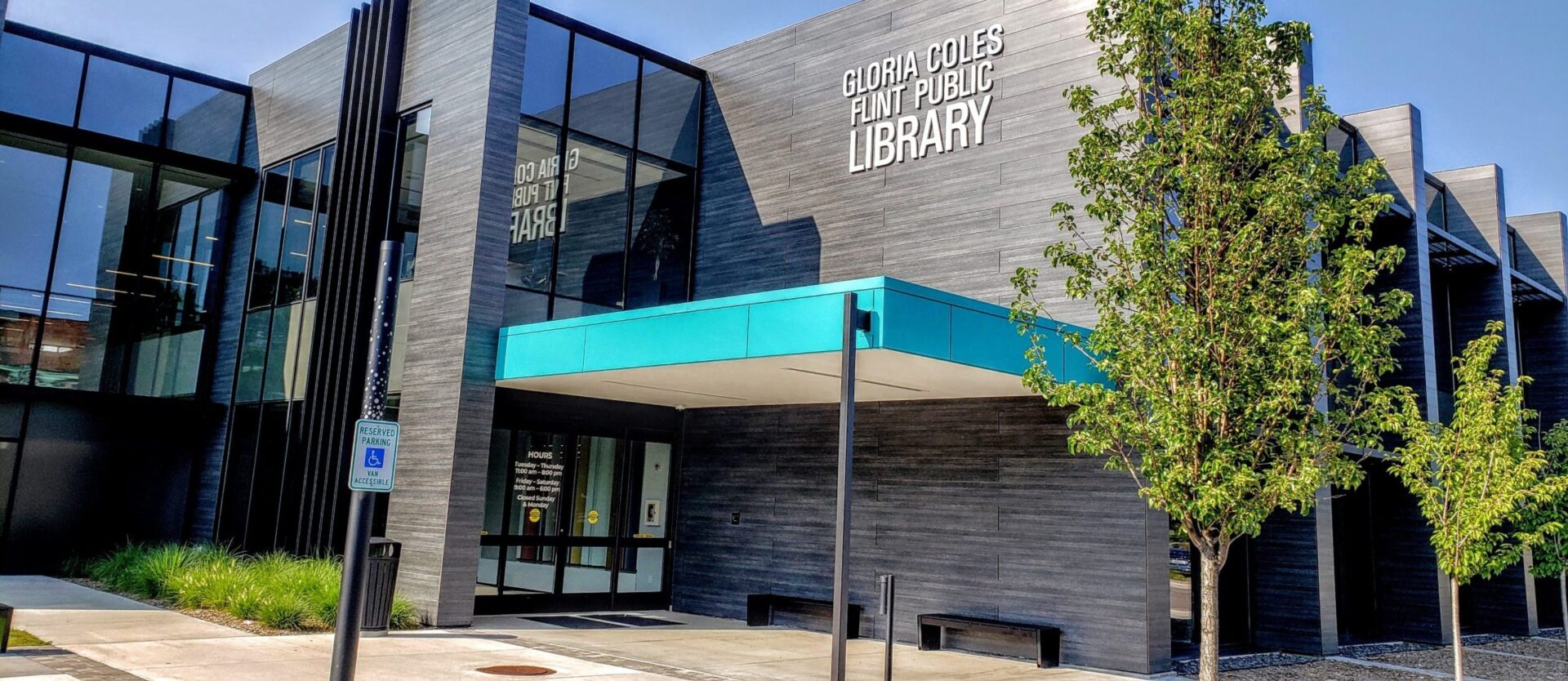
EVM has become part of the fabric of our city — so much so that bound volumes of past East Village Magazines are available in the Gloria Coles Flint Public Library. It has also trained hundreds of writers and reporters, been distributed by countless neighborhood volunteers, and has been led by just four editors: Gary Custer, Jan Worth, Tom Travis, and Kate Stockrahm.
Over those years, there were many times when the future seemed uncertain as funding was in doubt or writers and reporters were hard to recruit. We thank the Mott Foundation for its ongoing support, our advertisers and the generous donors who have stepped up to help us continue bringing local news to our neighbors’ doorsteps for five decades, and the volunteers who help distribute the magazine each month.
But, most of all, we thank our readers – you who have been here for us for 50 years. The challenges to local journalism remain, but we hope to continue delivering important news to you for many more years to come.
Lead image caption: East Village Magazine’s very first issue, published July 3, 1976.
Editor’s Note: A version of this article first appeared in East Village Magazine’s July 2026 issue.