By Flint. Daily. and EVM Staff
Voters in Flint’s Eighth Ward will have a new city council representative next year, as current Councilman Dennis Pfeiffer announced in January that he would not seek re-election. Pfeiffer, voted into office in 2021, will have served one term when he leaves office later this year.
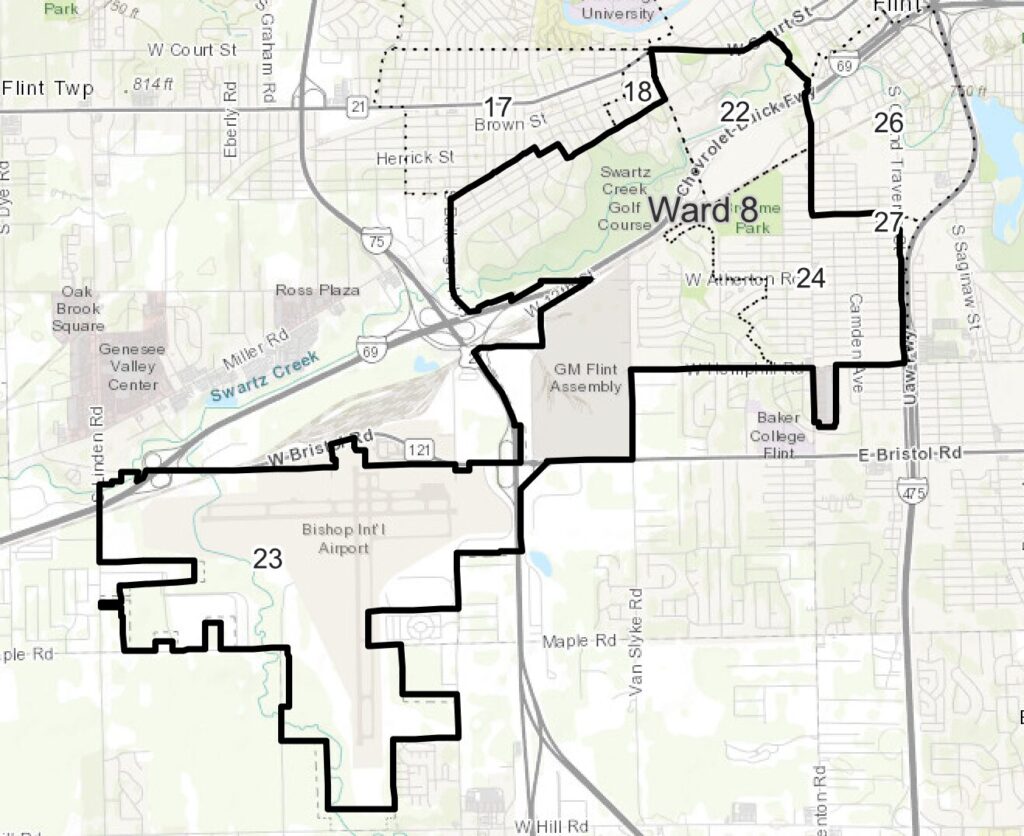
The Eighth Ward encompasses parts of the city’s west and south sides, including anchor institutions like Bishop International Airport, GM Flint Assembly, Broome Park, Flint Southwestern High School, and Powers Catholic High School. The ward’s boundaries are visible on the city’s interactive map.
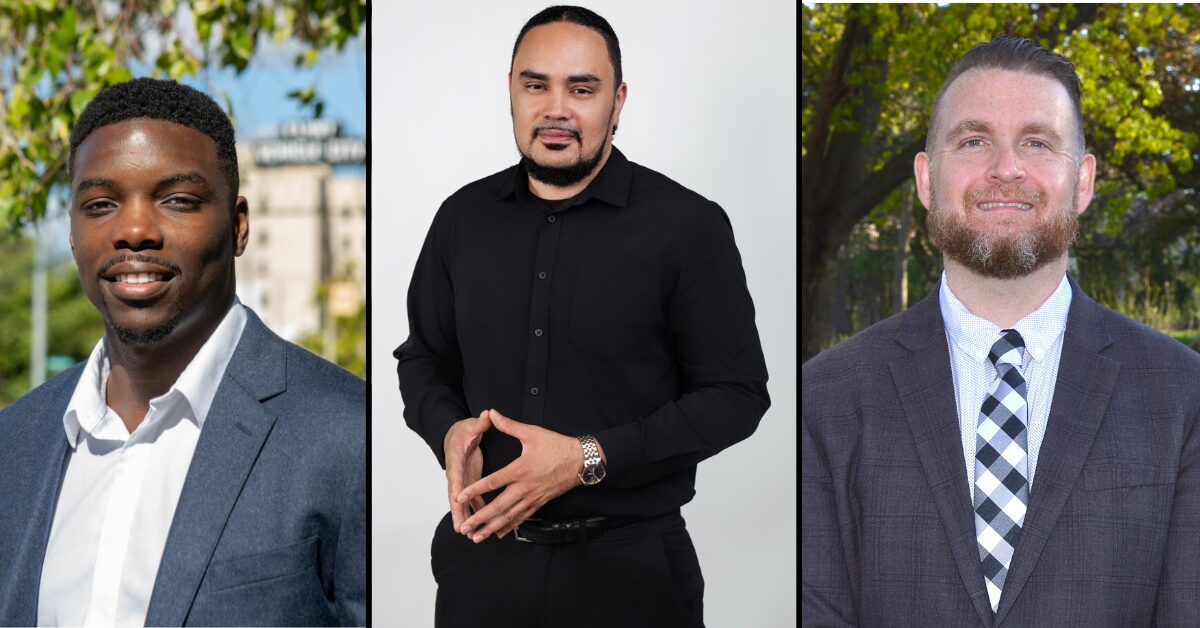
Three candidates are on the Aug. 4 primary ballot: Ezekiel Harris, Brandan Jamison, and Casey Lester. The top two vote-getters will advance and face each other in the general election on Nov. 3. All three responded to a questionnaire by East Village Magazine and Flint. Daily. leadership that was designed to provide readers with a brief snapshot of each candidate’s background, experience, history and connection with Flint, priorities should they win their seat, and their thoughts on recent examples of Flint City Council votes. Their responses are listed alphabetically by last name below.
More background about the questionnaire, our methodology, and the partnership between East Village Magazine and Flint. Daily. publications is available in our story announcing the collaboration last week.
We will publish one story each day in this order:
- Eighth Ward Primary – July 8
- Fifth Ward Primary – July 9
- Second Ward Primary – July 10
- First Ward Primary – July 11
- Mayoral Primary – July 12
All candidates in a primary, including certified write-ins, were contacted at their publicly-available email address and phone number listed on their filing forms to take part in this series. However, not every candidate responded to our questionnaire. It will be noted in the coming stories if a candidate did not respond and what attempts were made to contact them. For questions, please reach out to us at team@flintdaily.news or eastvillagemagazineflint@gmail.com.
Age:
- Ezekiel Harris: 34.
- Brandan Jamison: 37.
- Casey Lester: 41, will be 42 in November.
Occupation/relevant professional experience:
- Harris: Social entrepreneur and executive director of Co.act, a center for nonprofit support and innovation. Taught community and economic development at University of Detroit Mercy, led $250K–$2.5M community projects including a $2M, 12,000 sq. ft. mixed-use hub, Board Chair of Good Laundry, and social impact fellow with Harvard Business School.
- Jamison: My sister and I just started a shipping company that’s been pretty lucrative. I also helped build out a 130-acre cannabis farm in Clare up north. That’s where I got all of my economic development skills from. Before that, I was an on-air DJ at the radio station (93.7) for 13 years.
- Lester: I used to manage restaurants a while ago. I moved from that into banking, worked for Chase Bank, Huntington Bank, and now I’m at Oxford Bank. I am a treasury management manager, I manage a team of people who work with technology and banking, so fraud prevention, working with business owners trying to optimize cash flow, things of that nature.
Education:
- Harris: University of Michigan-Ann Arbor, Bachelor’s in Political Science, Captain of the Men’s Soccer Team.
- Jamison: I like to lean more into my business and entrepreneurial background, I think people relate more to that.
- Lester: I am two classes away from having a master’s degree from the University of Michigan-Flint. I’ve done my undergrad through UM-Flint, and now my postgraduate degree is going to be through UM-Flint, which is super exciting.
How long have you lived in Flint?
- Harris: 26 years.
- Jamison: Lifelong Flint resident.
- Lester: Since 2008.
How long have you lived in your ward?
- Harris: Six years.
- Jamison: Almost two years.
- Lester: We moved into a house in 2008 that was right on the border of the eighth ward. In 2013, we moved into our current house in Woodcroft Estates.
What neighborhood or area of your ward do you live in?
- Harris: Woodcroft Estates.
- Jamison: Westside of Flint.
- Lester: Woodcroft Estates.
Do you own or rent/lease a residence outside of your ward? If so, how often do you stay there?
- Harris: No. I do not own, rent, or lease a second residence outside of my ward where I live. I am part owner of a house in the 8th Ward where my dad lives.
- Jamison: No.
- Lester: No.
Do you promise voters that you will file your campaign finance statements by all required pre- and post-election deadlines for the primary and general election? If not, have you filed a Reporting Waiver and promise voters that your campaign will not receive or expend more than $1,000 in your election bid, per that waiver’s requirement?
- Harris: Yes.
- Jamison: Yes.
- Lester: I promise that I will, yes.
What things do you enjoy doing in the city for fun or in your spare time?
- Harris: I enjoy riding through the neighborhood with my kids, kayaking on Thread Lake, and going to the library. As a former college soccer player, I love taking my kids to Flint Style Soccer and to the growing tennis programs at the Flint Tennis Club.
- Jamison: I just enjoy doing what I can to promote collaboration. We have a lot of vacant spots in our city. I feel like in the past, in particular with Black culture, collaboration isn’t as easy as you see it when you step out of the city. I talk to young people who go to other areas, and they’re like, ‘How come every time we leave the city, the energy is different? But when we come back here, it’s just like a dark cloud.’ I think that a lot of that comes from the negative culture and lack of collaboration. I’ve always been a guy who has an open door policy. I’m in a position where I can actually step up. My relationship and my networking skills have helped me get involved in so many successful projects. You don’t get there unless you’re able to collaborate with the right people to get things done.
- Lester: My wife likes to golf a lot, so we go to Swartz Creek Golf Course, right off of Hammerberg Road. Flint Golf Club, we spend a lot of time swimming there at the pool with our kids. Sloan Museum, anything to do with the Cultural Center, we’re big fans of FIA, FIM. We eat downtown. We spend a lot of time at the Farmers’ Market. Spend a lot of time at Tenacity Brewing. Flint City Bucks games, we’re season ticket holders and have been for some time. Flint Style Soccer, which is an incredible program put on for the kids of Flint and it’s free and fun and effective. We do more in the city than we do out of the city, that’s for sure.
What boards or community organizations have you been involved with?
- Harris: I’m the Board Chair of Good Laundry, Member of the Flint & Genesee Chamber, Flint Tennis Club and volunteer with the Fairfield Neighborhood Association.
- Jamison: I’m on the city of Flint’s Ethics and Accountability board. I also recently founded my own nonprofit, the Common Ground Network, to start helping with free giveaways and other ways to help people who need it in my ward.
- Lester: I started doing civic stuff in 2015 during the water crisis, volunteering with an organization of people that were giving out water on Saginaw Street. I was on the Citizens Advisory Council for the Land Bank. I was appointed to the Flint School Board in 2019 and I became president in 2020. I joined the Neighborhood Engagement Hub and was president of that board for a while. I joined the Downtown Development Authority, and I’ve been on that since 2023. I currently do work with Latinx Technology Center, I’ve helped out at FIM, FIA, Sloan.
What made you decide to run for City Council?
- Harris: I decided to run for City Council because families in Flint deserve reliable services, safe neighborhoods, and real economic opportunity. As a husband and father raising three children here with more than a decade of community and economic development experience, I see both our potential and the gaps holding us back, and I’m ready to help close that gap.
- Jamison: Seeing how varied some of the politics are in Flint and how unorganized we are. I know a good chunk of the people on council and the people running and have worked directly with them. That inspired me to get up there and be the guy to bring everyone together. We have a once in a lifetime opportunity in Flint. Everything that we’re doing now in these next 10 to 20 years will be the new face for Flint for the next couple hundred years. It’s even more important to unite and not go down the road that we’ve been going right now, and I think I’m perfect for that because I take pride in helping people unite.
- Lester: One of the hardest things for me is every time someone asks, “Where do you live?” And I say, “I live in the city of Flint,” they say, “How’s the water?” Or, “Oh, this is the city with all the crazy council meetings.” I am so proud and happy of my city, and so thankful for all the opportunity it’s provided. Flint has provided so much for my children, for my family, that when people have that immediate reaction, it is so upsetting. So if you identify an issue and don’t offer a solution, you’re just complaining, right? I wanna try to do what I can to get in there and help out. If I can make a difference, great. I want to make our politics boring. I don’t want it to be a source of entertainment for people outside of our city to just watch and make fun of us. I want that to come to an end.
What separates you from other candidates in your primary election race?
- Harris: I’m the only candidate who combines being born and raised in Flint, sending my children to Flint Community Schools, and bringing more than a decade of hands-on community and economic development experience. I’ve led real multimillion-dollar projects that improved neighborhoods, supported small businesses, and brought new resources into communities. I know how to navigate complex systems, build partnerships, and deliver visible results for the 8th Ward.
- Jamison: I think it’s my wealth of experience. Given my track record, leaning heavy into my radio station experience, it allowed me to get knee-deep into the community, be behind every door, be behind every organization, and see what people’s real intentions are. You got candidates who are running in pretty much every ward I’ve had experience working with. I’m probably the most heavily experienced in the aspects of collaboration and networking. I have over a decade of experience of collaboration.
- Lester: Brandan and Ezekiel are wonderful humans. They’re strong, kind people. I’m fortunate to be competing with people of stout character. Those are our similarities. People of faith, family men, we need that across the city. The difference for me, it’s my experience. I’ve been in and around the city a long time. I’ve been doing the work at events, volunteer engagements, doing all of the things I can to consistently give back. I’ve been working in and around government on the school board and on the DDA. I have experience fighting for our city at the state level. Myself and other school board members had to go to Lansing to work with the State Superintendent, Michael Rice at the time. I don’t know that the other gentlemen have that same experience within the city. Not to say that they haven’t done nice things in other places. But Flint is a unique city. If you don’t have a lot of that past knowledge, the historic trauma that’s come with what we’ve seen, it doesn’t always translate that well.
The City Council has long been plagued by difficult working relationships among council members and with the mayor’s office. How would you create a healthier environment on council and with the mayor to move city business forward?
- Harris: I will help create a healthier environment by listening first, treating differences as valuable, and refusing to engage in personal attacks or drama. By showing up prepared, communicating clearly, and following through on commitments, I’ll build trust with colleagues and the mayor’s office so we can focus on solving problems and moving city business forward for residents.
- Jamison: I’ve already worked with many people on council and candidates in different ways. I know how to collaborate and work together. There are definitely forces that have their own individual purpose to why they will want a particular candidate in position. And I think the council more than ever needs to sit down, collaborate, and all be on the same page and understand how important it is to push outside forces from coming in to manipulate our candidates in aspects of what’s right for the city, and not allow any outside forces to erode that team. That team needs to be tighter than what it is. A very toxic environment just holds us back from developing like we should.
- Lester: I don’t attend every argument I’m invited to. One of the things that we’ve been plagued with is this concept of TikTok politics, where we’re not fighting for our constituents, we’re fighting for followers on our social media pages. I have no desire for that. I’m not trying to go viral. My goal is to move the city forward. When I was on the school board, we always said, ‘Is this decision moving our children in the right direction?’ If the answer to that isn’t a clear yes, we shouldn’t be having that conversation. Arguing on camera is not moving our city forward, so that’s something that we would need to stop. I am generally not an argumentative person. I’m not a hardliner on anything. There’s going to be good and bad on both sides. There’s going to be points that make sense for everybody, and I don’t exist in a world where I think I’m the only one who’s right. I operate from a perspective of, ‘Here’s my idea. Please tell me where I’m wrong, and let’s work to figure it out together.’
What do you see as the biggest challenges facing the city?
- Harris: Flint’s challenges are real, but so is our resilience. We face negative perceptions, unreliable basic services, and aging infrastructure in too many neighborhoods, yet I see a city that has survived the worst and is ready to rebuild systems, restore trust, and create new opportunities that honor our history and our people.
- Jamison: The city is populated with saboteurs who plant seeds of destruction in our media, on our social media, for those who can’t discern good intentions versus those who make these false statements or twist the news. Dave Chappelle said it best, we’re in the age of spin. And so social media is actively being used as a tool to corrupt our base in the city of Flint, and they don’t understand what’s really going on. The average working man doesn’t have time to show up to a lot of these events. They don’t know what’s going on. They don’t understand what’s happening out on the streets. I’ve been out here myself and worked in media long enough as a radio journalist to be able to understand what I’m actually seeing and seeing these elements that are not only being used here, but have been used successfully in other countries overseas, these campaigns of misinformation that can corrupt people’s minds. I think we’re in the midst of a crisis of misinformation in the city of Flint.
- Lester: Crime, gun violence specifically. We just had another shooting, and that is a result of systemic issues that have happened historically. It’s not a ‘today people wake up and decide to commit a crime’ thing. Things have led to that. Understanding where those issues came from historically would help. The other issue is blight. We have neighborhoods that are falling into disrepair because people aren’t taking care of their property. We have a lot of abandoned homes. We have a lot of things that just haven’t been kept up, whether it’s from the city, from the Land Bank, from the county, any of those things. And then we need a better community space. We need people who are 18-35 to have an environment they can go be a part of, meet people, have good access to entertainment, and not have to do everything at a bar. Not that there’s anything wrong with that, but they need other environments to engage with each other, and I don’t think that we have a ton of that opportunity right now.
What do you see as Flint’s greatest assets or opportunities for the future?
- Harris: Flint’s greatest asset is its people: resilient neighbors, creative young professionals, and community leaders who keep showing up. We also have strong community anchors like our colleges, hospitals, and cultural institutions, historic neighborhoods with great housing, and a strategic location between major job centers. If we invest in residents, fix core systems, and support small businesses, these strengths can become safer neighborhoods, good jobs, and a more vibrant city for the next generation.
- Jamison: There are a lot of opportunities for development, that’s why you see so many big companies trying to come in here – they can see money, they see big swaths of open land, and they’re coming in trying to snatch it up for a dime on the dollar. That is our asset, that is our gold, and I think that should be kept by the people of Flint, especially those who suffered through the water crisis. Our own people need to be the ones to reap those rewards and those benefits. We are living in a city of gold if you understand development.
- Lester: Flint’s greatest assets 100% are its people. I think we have some of the most incredible people you will ever meet. We have passion, we have intelligence, we have power, we have pride, we have all of the things within our city that we would need to make it just the best city ever. Our young people, we have such a diverse collection of youth within our city that is looking to do better things. They wanna be involved, they wanna be together, they wanna be engaged. All of those things combined will create a power that’s unstoppable. What holds us back is the ability to do it without going through nonsense at a government level. Without getting into hurdles and logistics and all of that. We have people, we have economic development that can happen. We have some incredible resources here in the city that just need to be utilized a little better.
What would be your three top priorities should you be elected?
- Harris: My three top priorities would be reliable basic services, safer neighborhoods, and more economic opportunity. First, I would focus on fixing the basics people feel every day: streets, lighting, blight, and responsiveness when residents call for help. Second, I would work with neighbors, schools, and law enforcement on practical safety improvements, especially for kids and seniors. Third, I would push to bring investment, support small businesses, and create pathways to good jobs so families can afford to stay and thrive in Flint.
- Jamison: First would be expediting development and making sure that whatever jobs we are targeting, the taxpayer is getting the maximum benefit for their dollar. Having extensive experience in development and construction, I know how much something should cost, I have a wealth of experience, and will be able to sit down and go over a budget. Second, I would like to sit down with local law enforcement and identify more hot zones in the area and improve response times. A major thing I’ve been hearing is police response times are awful in my ward and there are some areas that feel ignored while the wealthier areas are taken care of. I’ll be the first to speak up for law enforcement because I think they are overworked and underpaid, they’re here to help serve the community and improve it, so it’s about finding more ways to work with them and engage with them. Third is blight, you have to fix the blight to help improve development and safety.
- Lester: We’ve been talking to residents and asking them what they want to see. Number one, they want a more visible police presence. Atherton Road, Fenton Road, Miller Road, for example, have become an absolute racetrack where people are flying down the road, passing in the turning lane. A lot of residents have asked to have more police to help create a safer space for kids to play, ride bikes, things like that. Two is blight. There are so many homes that people aren’t mowing, they’re not taking care of stuff. They’re parking cars on the lawn. They have garbage stacked up on the side. Nobody’s enforcing that. There’s no people able to go take care of that. Then the last thing that everybody has said specifically for my ward is, “I want to be able to get in contact with my council person. I wanna be able to just reach out and say, ‘Hey, this is what’s going on.'” Whether it’s a phone call, a text, email, people want to be able to get in contact with their council person and not feel overlooked.
The Flint City Council recently passed a 1-year moratorium on data center developments in the city. Do you agree with that resolution? Why or why not?
- Harris: I support the 1-year moratorium on data center developments as a necessary pause to protect Flint’s long-term interests. In this year, we should set clear standards for community benefits, jobs for local residents, environmental protections, and fair use of our water, power, and land so that any future large-scale development actually strengthen neighborhoods instead of draining resources or locking us into bad deals.
- Jamison: I know it seems like in the local environment in general, they seem like something only a few can actually benefit from. I do understand that globally though, when it comes to geopolitics, we are absolutely in a race with AI when it comes to other countries. So, with these companies, thank you for wanting to pick Flint as a spot for a data center, but if it’s not actively bringing in more jobs and more tax revenue to the local residents, I’m not for it, and I don’t see how a data center can actually do that. It doesn’t seem beneficial in any way outside of benefiting a few in a global race to where I don’t even think we’re in position to win. I don’t honestly feel like throwing Flint into the race to build a data center would do anything in the long run. So we might as well save our people the headache of putting this thing up and artificially raising bills for no reason.
- Lester: I don’t disagree and I don’t agree. I don’t know that we have enough accurate data right now to put a complete stop on it for a year. I would like to see more things come through committee properly. I would like to see the process work. A moratorium is an immediate stop. I think as a city, we do need better economic development. I think we need more access to jobs, and we need a viable tax base that helps build us up. I don’t know for sure that that’s a data center. What I do know is that when we stop the conversation in the very beginning, we eliminate the possibility. We don’t know yet. I don’t know that I agree or disagree with data centers currently. My gut instinct says that it’s not what we want. But I also think that hard stop is also not what we need. We need to be able to have a constructive conversation. Even if we disagree along the way, let’s flesh out the entirety of it and figure out exactly does this make sense, and then have informed conversations with residents.
The Flint City Council recently passed a permanent resolution recognizing June as Pride Month in honor of Flint’s LGBTQIA+ residents. Do you support that resolution? Why or why not?
- Harris: I support the resolution recognizing June as Pride Month because City Council’s job is to serve all residents. As a Christian, I believe every neighbor deserves safety, dignity, and to see their lives reflected in the place they call home, and this resolution honors Flint’s LGBTQIA+ residents and their contributions to our city.
- Jamison: I don’t want anything that will necessarily put a wrong inflection on the youth and perpetuate an ideology. I feel like we definitely need to give people their peace, but I do feel like there’ve been some instances where they’ve kinda overstepped a little bit in the aspects of the LGBTQ community, and that’s okay to say because there’s been other times where other communities have overstepped as well. Without coming off as disrespectful, I know there’s been some times with that community, if you try to criticize anything they do, they tend to bite your head off. I’m not here to cause a fight, but based on my faith, I don’t want to necessarily enforce anything that also makes anyone else who has any religious background feel uncomfortable. I’m gonna do anything I can to support everyone, but I don’t want to isolate anything as well.
- Lester: Yeah, I support it. I think that we have gotten into a habit of aligning ourselves with political parties instead of looking at an actual situation. I think there are certain things on a political spectrum that people say, ‘I have to do this because this is how I vote,’ and so they have to do that. With June being Pride Month, I have no issues with that whatsoever. I think people wanna celebrate how they wanna celebrate, and I think that’s great.
Have you ever been charged with or convicted of a violent or financial crime, and if so, how was it resolved? [EDITOR’s NOTE: This question is not intended as a judgement on a candidate’s criminal history. We do not believe that a criminal history should be a barrier to anyone holding elected office. Rather, this is an opportunity for a candidate to directly respond to voters regarding any public criminal or financial records or accusations that do exist in the public domain and address them in their own words.]
- Harris: No.
- Jamison: No.
- Lester: No. Had I been convicted of a financial crime or a violent crime, I wouldn’t be able to work in banking. My background check is clear.
Do you have a campaign website or social media pages for voters to learn more about you?
- Harris: Website, Facebook, and LinkedIn.
- Jamison: My Facebook is Brandan B-Ray Jamison. I’m also on TikTok. You can get a clear message across via TikTok, Flint’s TikTok is still a ground for positive information. I think Flint’s Facebook audience is corrupted with misinformation.
- Lester: Facebook page.
Lead photo caption: The City of Flint’s Eighth Ward Flint City Council candidates for the 2026 primary election on August 4, 2026. From left to right: Ezekiel Harris, Brandan Jamison, and Casey Lester. (Photos courtesy of the candidates)